Gideon Adeyemi
Product Designer
London, UK
20:11:58
Jóga, Björk ...


Product
Forge
Role
UX Designer
###
Marketing, AI, SaaS, Operations
Platform
Web
Problem
Sales teams drown in inefficiency; reps spend 70% of their time on non-sales admin work, with only 24.3% of reps hitting quota; operational context is lost across disconnected tools (CRM, Slack, docs), and performance management is broken due to managerial ambiguity.
Solution
I designed the sales team management platform built around 6 pillars: Smart Summaries, Goals, Spotlight, Resources, Awards, and Community, with AI embedded throughout to handle the memory work, surface insights, and turn scattered context into a single operating rhythm.
Impact
- 100% adoption by Beta users - 89% active users
- 1:1 prep time reduced by half.
- Quota attainment increased from 28% to 71%
- Better goal tracking and overall team alignment
- Significant increase in sales performance, reps credited it to tool automation, and rewards.
Product
Forge
Role
UX Designer
###
Marketing, AI, SaaS, Operations
Platform
Web
Problem
Sales teams drown in inefficiency; reps spend 70% of their time on non-sales admin work, with only 24.3% of reps hitting quota; operational context is lost across disconnected tools (CRM, Slack, docs), and performance management is broken due to managerial ambiguity.
Solution
I designed the sales team management platform built around 6 pillars: Smart Summaries, Goals, Spotlight, Resources, Awards, and Community, with AI embedded throughout to handle the memory work, surface insights, and turn scattered context into a single operating rhythm.
Impact
- 100% adoption by Beta users - 89% active users
- 1:1 prep time reduced by half.
- Quota attainment increased from 28% to 71%
- Better goal tracking and overall team alignment
- Significant increase in sales performance, reps credited it to tool automation, and rewards.
How Marketing Teams Became 10x Efficient Through AI-powered Centralised Operations Software and Gamification
The impact:
12 weeks after launch, Forge achieved 100% adoption across all the onboarded sales teams. Team leaders reported improved management effectiveness, greater operational efficiency, and significantly reduced 1:1 preparation time. Over the same period, pilot-team quota attainment increased from 28% to 71%, fueled by workflow automation and performance-driven competition that boosted individual productivity.
The deck Dave shared clearly defined a problem: "Sales teams today are more disconnected, mismanaged, and inefficient than ever. 70% of reps' time is spent on non-selling tasks, with only 24.3% hitting quota, leading to £84 billion lost annually in the UK alone to bad management."

Dave's proposed 6-pillar solution
Forge was Dave’s answer. A sales team management platform built for everything CRMs ignore: 1:1s, OKRs, coaching, performance reviews, recognition. He'd sketched a six-pillar solution: Organise, Structure, Engage, Review, Recognise, Share. My job was to take that thesis and design a product around it. Here's what we shipped on completion:

What the numbers were hiding
The brief had an unclear problem. "Disconnected, mismanaged, inefficient" could mean a hundred different things. Before designing anything, I did extensive market research and root cause analysis along with other members of the team to clearly define the actual factors causing these problems:
- Low quota achievement among sales reps
- Inefficient sales team management leading to revenue loss
- Poor management of sales tasks beyond CRM activities

What we found reframed the problem. An underlying cause of these problems was that sales reps spend too much time on non-selling tasks due to the fact that these different tasks lived in different tools, and the manager was the integration layer. OKRs in a Google Doc. KPIs in Salesforce. Discussion topics in Slack. Each handoff lost context. Each lost context increased the time spent on mediocre admin activities rather than the actual sales tasks. Another problem was that managers had to set up training and monitor performance and metrics of the entire sales team manually: performance reviews in Word, commission in Excel, and recognition nowhere at all. All of these are causing admin fatigue, slow management handoff, and broken communication.

The ambiguous problems became defined: sales managers don't have an operating system. They have a disjoint and inefficient stack. This design needed to consolidate the full stack in one place, make it very efficient to replace the scattered stack and guarantee the teams' higher focus on closing deals.

The six pillars designed to share context
Dave's original framework: Organise, Structure, Engage, Review, Recognise, and Share all held up under the research. Each verb mapped to a distinct mode of work that managers were doing badly. Each needed its own surface, its own design treatment, and its own answer to the problems.
What changed was the underlying logic. Originally, each pillar was conceived as a separate feature set. After research, I proposed that they had to share one data model and one AI layer underneath, so context could flow between them automatically. An OKR set in Structure should appear in an Organise briefing, surface in a Review dashboard, factor into a Recognise award, and feed back into the next round of goal-setting. I designed the pillars as the surfaces and the product as the shared brain between them.
This decision was born from the reframing of the problem; it gave me clearer insights to address the problem, not the symptoms.
Organise
This was the heart of the product, so I designed it first. The core problem: managers were burning hours every week assembling context that lived everywhere except where they needed it.
Iterations & Feedback:
I designed the key features from sales team's existing stack, like CRM, comms, and more, into Forge. I tested with a few managers, and they were keen on not willing to move their existing data from the other tools to Forge due to the volume of data they have on there and adoption difficulties for team members.
I researched integrations with these existing software to see if we could leverage their data in Forge to provide value for the sales teams. This was possible across the majority of the tools, so I designed the information system and feature architecture first with this in mind. A few steps of integration with existing stack provided Forge with all it needed to organise and optimise the entire operation. This worked and was well received by the teams testing.

Smart Summaries: the daily home
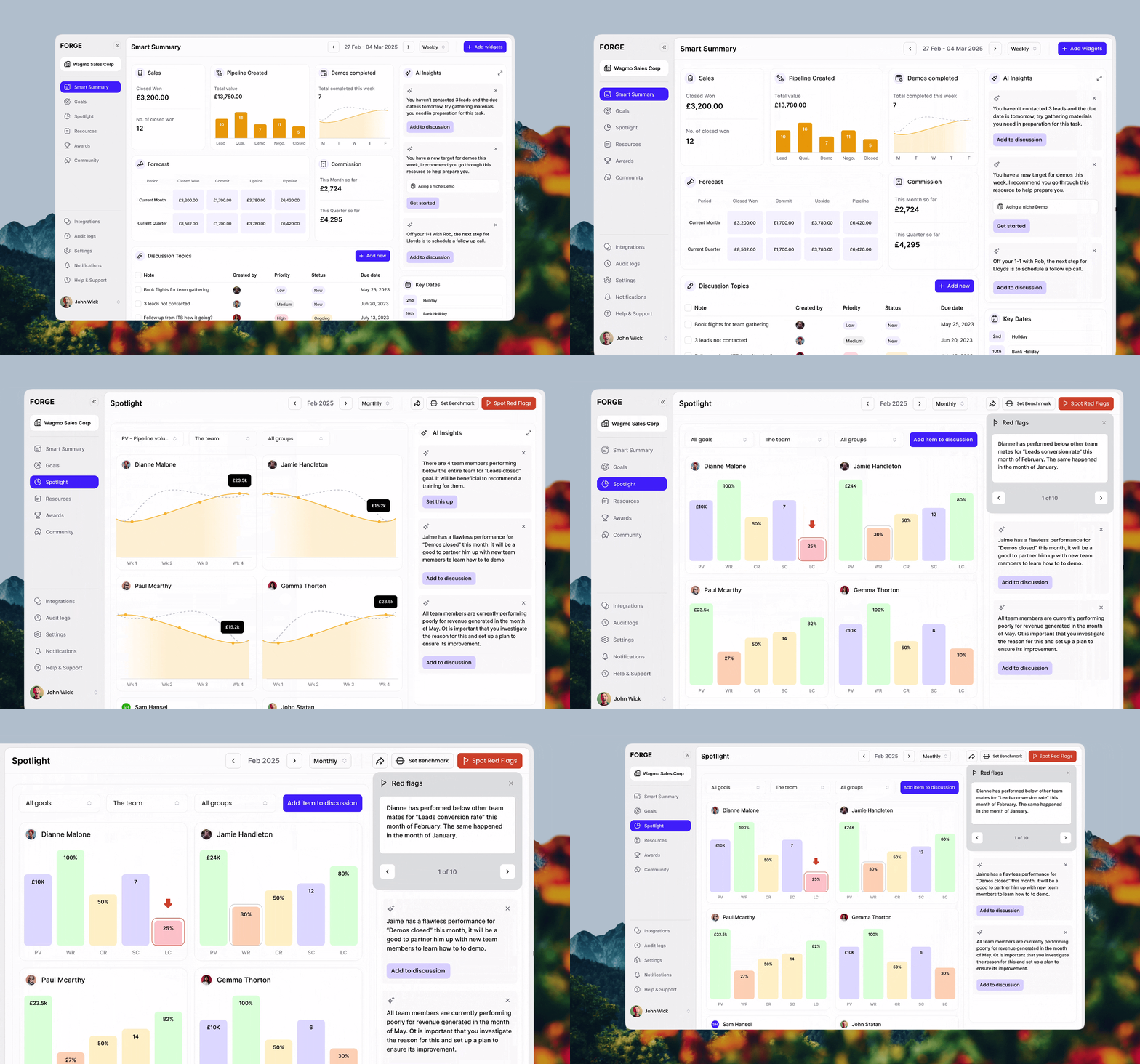
I designed the smart summary that helps organise the entire team operation as a morning brief for the managers and team members: a single editable surface that pulls discussion topics, KPI deltas, key dates, follow-ups, OKR progress, and commission tracking into one place the manager and team members can see.
The widget panel holds content across the modules (Summary, OKRs, Reviews, Training, History) so managers can drill into any pillar without leaving the view. The top section pulls live CRM data (Bookings, Pipeline, Demos, Forecast, Commission). The bottom holds Discussion Topics: a continuous, two-way feed where managers and reps add agenda items with priority and status. The right rail holds Key Dates, follow-ups and AI insights. Every tile is configurable, so a number-driven manager and a story-driven manager can both make it theirs.
Structure: Goals - managing team OKRs and PIPs
Our research showed that managers struggle when writing OKRs from scratch, and sales reps often track goals that have nothing to do with their development.
The Goals surface had to do two things. For managers: a library of pre-built OKR templates by role and stage with customisation affordances, so the cognitive cost of starting is zero. For reps: a Personal Goals Tracker that ties to the OKRs set by the manager and lives alongside revenue targets: promotion planning, skill development, the things people actually care about. To handle responsibility and accountability, I designed an “Action plans” feature for team members; the status of these plans is automatically tied to the goals and reported to the manager.
I designed the action plan feature like LEGO blocks with affordances for teams to use it for any type of activity sequence leading to a goal. The same building blocks can be used for performance improvement plans, onboarding guides, and more. Finally, I designed appraisals to connect back to the OKRs they measured.
Alternatives & Results:
- I designed a freeform OKR builder first, but this was not as efficient because managers froze when they realised they needed to create it all from scratch.
- I designed a step-by-step wizard for OKR creation. This performed better, but managers also wanted to be able to personalise industry-standard OKRs
I shipped all these before landing on the industry-standard template-plus-customise model for setting up and managing goals; this yielded a better result.
Review: Spotlight - performance without punishment
Performance review was manually carried out and tracked in intervals. Managers wrote reviews from memory; reps experienced ambush; managers spot issues only during the next review, which might not come till after 3 months. Imagine running this for a large team; it becomes overwhelming, reps don’t get immediate guidance, and the team gradually becomes inefficient.
I designed the “Spotlight” to solve all these. Multi-period bird's-eye view to track team performance, Affordance to drill down to individual reps, benchmarking, and a Traffic Light system for at-a-glance review. Most importantly, this design tied the spotlight back to the OKRs in Goals, giving the manager an automated performance tracking system in sync with the team's goals.
A key design decision I made that dropped the jaw of the managers was the implementation of “Red flags” - a proactive UX feature in Spotlight that helps managers automatically identify team members who are performing below other team members in different metrics. I designed this feature to leverage AI embedded in Forge to spot anomalies in team performance and notify managers. Managers can see them on the spotlight page; they also get a notification via email about the red flag and how to manage the situation. Finally, with the context available, the AI recommends actions to mitigate the performance issue.
Another major interaction I designed that made this easy to use was the ability for managers to click on an area on the chart and add the context of the selected area to discussions, which then shows up in the smart summary page. A manager might see that performance as concerning and want to discuss it in a 1 to 1 with the rep, or maybe excellent, and he wants to appreciate the rep.
Engage: Learning resources as a marketplace
Most sales training tools are LMS knockoffs. Forced courses that are not aligned with the team’s context. Reps hate them, and managers ignore them.
I designed the Resource library to take a different shape: a depository where senior leaders could publish frameworks, sales training modules from internal experts, and a contributor marketplace that let great managers (inside the company and out) become known voices. I also added AI-generated post-viewing quizzes for self-checks; assignable but never mandatory. Quiz completion was 71% when self-initiated and 23% when mandated, which is why we shipped the toggle. (We learned this the hard way; first version made quizzes default-on.)
Most importantly, the resource library is now connected to the team’s context and can also recommend different resources to individual reps based on their current activities and performance.

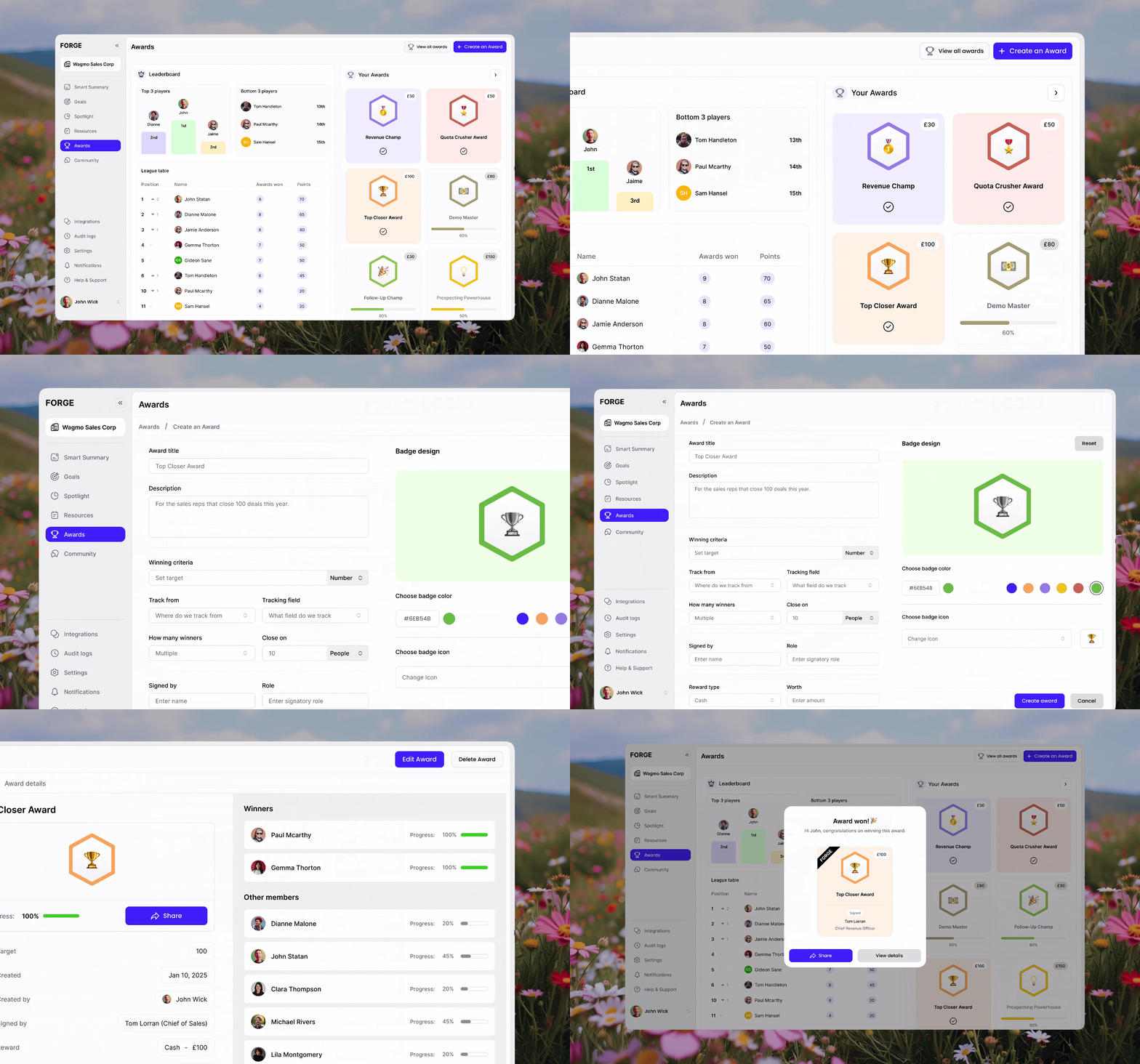
Recognise: Awards as a reward and a portfolio
Managers used sales gamification platforms that operate a public leaderboard model tied to the reps' sales performance; we chose to go the same route. If it works, why change it? However, we tested this model and found out that it motivated the top 10% only and demoralised the rest. This was a bad outcome.
Through more evaluation, I discovered that reps actually love the leaderboard style, but because the leaderboard was tied to their sales performance directly, they had an issue with what it represented. It meant that being at the bottom of the table shows that you are not good at your job; this was the problem.
I redesigned the Awards feature around a Trophy Cabinet that worked like a personal portfolio. Private by default. Reps choose what to share. The Cabinet shows full history: Top Sales Performer 2025, President's Club 2024, Best New Starter... We then designed a leaderboard that tracks how many awards you have received. So now the leaderboard is tied to awards as collectibles and not the sales performance. Managers create these awards and allocate Incentives to each award. I designed the awards to have a “Signed by” to boost the credibility when reps share on LinkedIn. This model worked and was one of the most talked-about experiences of the tool by sales reps.
How AI silently did the work
I designed the AI to run underneath all six pillars, but it never got a feature page of its own. In Smart Summaries, it pulls data from recorded meetings, documents, activities, and team performances to curate daily briefings. In Goals, it suggests OKRs based on team patterns and analyses performance to recommend actions. In Spotlight, it powers reporting, red flag detection, and recommendations. In Engage, it generates post-viewing quizzes. In Awards, it drafts recognition narratives that the managers can edit. Beyond this, it ties all six together in value, making the whole system interconnected. It can see that a team member is performing poorly in closing deals (Spotlight); it then goes ahead to recommend learning materials (Resources) to the team member to improve that skill.
The principle I held across every surface: AI prepares, humans decide. Every AI suggestion shows its sources. Every recommendation is editable when added to the discussion. When confidence is low, the AI uses phrases like "worth checking in directly to be certain" rather than inventing certainty.
I steered clear of AI chatbots and leaned towards embedded intelligence for contextual insights in every phase and feature of the product to make the features smarter, retain context, and improve automation, rather than surfacing these in a confined prompt-requiring chat.
What changed
- 1:1 prep time reduced by half.
- Beta users' quota attainment increased from 28% to 71%
- Managers reported better goal tracking and team alignment
- Managers experienced a significant increase in reps' sales performance; they credited it to Forge’s admin automation and the awards and incentives
- Onboarded managers reported that sales management got easier with Forge.
- 100% tool adoption from Beta users
- Daily active use: 89% of seats opened Forge daily by month three
- Pillar adoption at day 90: Organise 91%, Structure 76%, Spotlight 73%, Recognise 67%, Engage 58%, Share 41%
Lessons Learnt
What worked
Designing the six pillars as one shared data layer (rather than six features stitched together) was the structural decision that made everything else click. Treating AI as connective tissue, not the headline, kept the product trustworthy.
Reinventing the wheel is not always the answer, especially if the cost is high. Building multiple features that teams already have tools for was not the right choice; integration was.
Never let users start from nothing; the mental requirement to build things from scratch can ruin the entire experience of a product.
Automate as much as possible, with friction where needed.
Conventions aren't always the best; there is always a problem yet to be seen. I could have designed the leaderboard like other platforms, but it would've failed.
What I'd do differently:
Our first weeks of research were too manager-heavy. The features reps merely tolerated (early gamification, mandatory quizzes, an AI sentiment analysis tool we eventually removed for being a "snitch line" ) all came from that imbalance. Talk to reps from week one next time.
0%...
Because the smallest design
decisions can change how we
all experience the world...