Gideon Adeyemi
Product Designer
London, UK
20:11:58
Jóga, Björk ...


Product
Pennee
Role
Product Designer
###
Finance, Credit, BNPL
Platform
Mobile
Problem
Pennee’s cash-based credit model gave business owners access to credit, but the money often went toward non-business needs. The challenge was making sure credit actually financed the business without making it too restrictive.
Solution
We rebuilt the credit model around direct asset financing to keep it focused on business needs. I designed the new credit experience alongside simpler KYC, transparent verification, and better credit management, making the new credit model restricted to business use and easier to manage.
Impact
- 72,000+ businesses were activated.
- Credit used for business went from 16% to 97%.
- KYC completion increased from 24% to 81%.
- Verification time dropped from 48hrs to 20hrs.
- Repaid loans increased by 28%.
- Active loans increased by 50%.
Product
Pennee
Role
Product Designer
###
Finance, Credit, BNPL
Platform
Mobile
Problem
Pennee’s cash-based credit model gave business owners access to credit, but the money often went toward non-business needs. The challenge was making sure credit actually financed the business without making it too restrictive.
Solution
We rebuilt the credit model around direct asset financing to keep it focused on business needs. I designed the new credit experience alongside simpler KYC, transparent verification, and better credit management, making the new credit model restricted to business use and easier to manage.
Impact
- 72,000+ businesses were activated.
- Credit used for business went from 16% to 97%.
- KYC completion increased from 24% to 81%.
- Verification time dropped from 48hrs to 20hrs.
- Repaid loans increased by 28%.
- Active loans increased by 50%.
Credit for Small Businesses: Unlocking 72k+ Users for Pennee and Eliminating Bottlenecks in the Product’s Experience
With the previous credit product, Pennee had activated about 15,000 small business owners, financed in the traditional way: straight cash disbursement.
In the ten months after we rebuilt the credit process and the journey around onboarding, credit verification and loan management, we activated over 72,000 total businesses, nearly 5× the previous total.
Pennee is a credit company that gives small business owners a credit line, restricted to business use, alongside the cashflow tools to manage it day to day.
Initially, we financed business owners by giving them cash. It made sense on paper: they needed money, so we gave them money. But the model wasn't solving the problem we built it for. The owners who stuck around were often using the cash for things outside their businesses.
They needed financing. We just weren't giving it to them the right way.
The goal of this redesign was to understand the reasons for poor business growth, find a better way to solve their money problem while keeping the financing within the business, and rebuild the credit product around that.
I worked as a product designer alongside other designers, engineers and the wider product team. My specific ownership was the credit experience, taking the cash-based model apart and rebuilding it around direct asset financing.
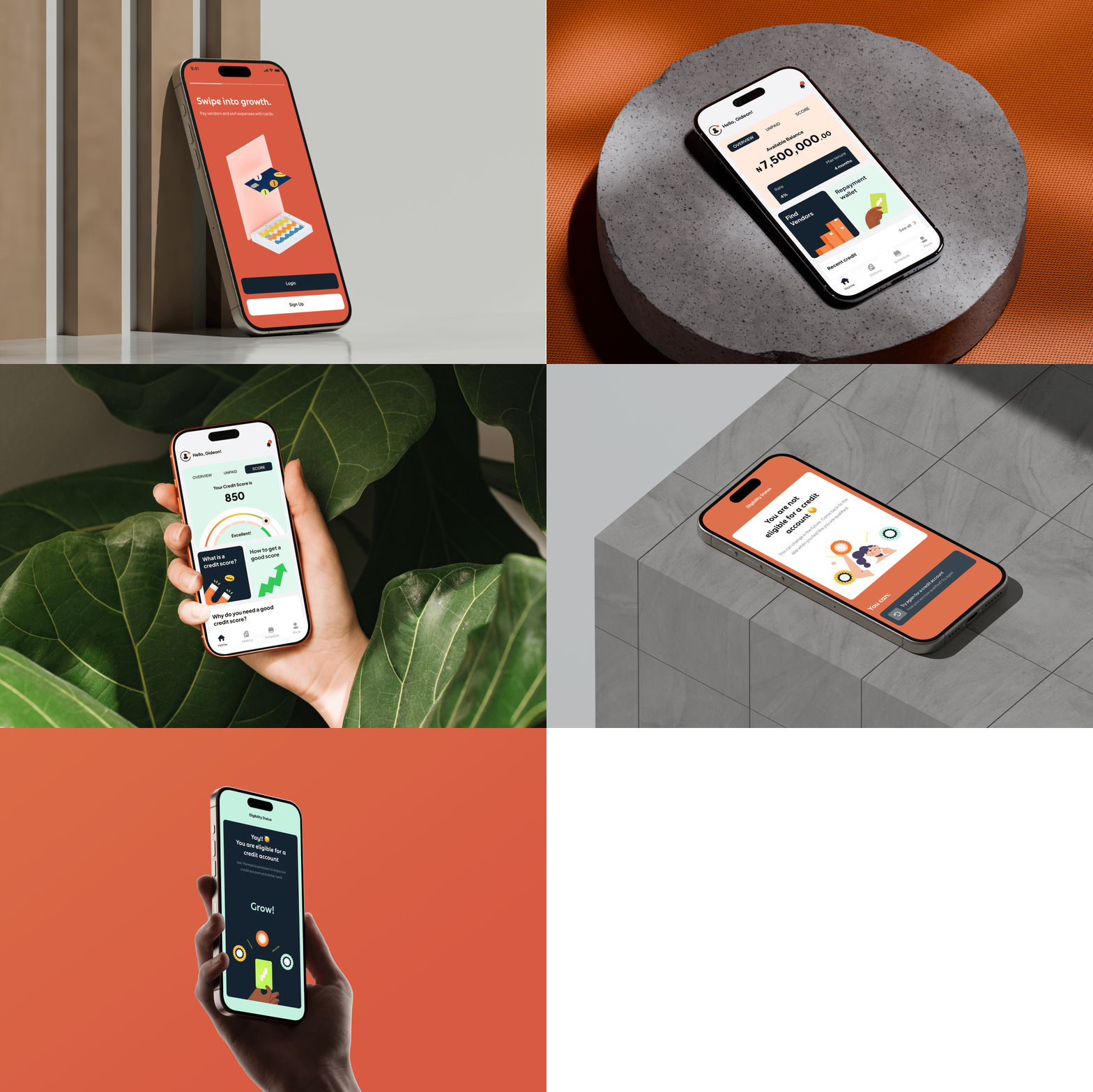

The Challenge
1 in 3 small businesses don't make it past 18 months. The reason is almost always the same: not enough money to stay alive. Fewer than 5% have ever accessed bank credit, and the consultants and experts who could help often cost more than these businesses can afford.
We'd tried closing that gap once by giving business owners cash directly. In practice, it fell flat. The owners who used Pennee often spent the money on personal expenses. All real needs, but none of them were what the credit line was built to finance. And when the money didn't reach the business, it affected the business's ability to stay afloat and, eventually, our repayment forecasts.
That wasn't proof business owners didn't need financing. It was proof we hadn't figured out how to deliver financing in a way that reliably reached the business.
So the redesign started with a harder question: How do we make financing effective for the business, not just accessible to the business owner?
The financing model, KYC, verification and repayment experience all came out of trying to answer this question.

Market Research
Once we knew cash wasn't working, the question shifted from whether business owners needed credit to what credit had to look like for it to actually reach their businesses. I looked at what was already happening inside the product through transaction analytics. Cash was leaking into non-business expenses, and the default patterns that followed showed us that simply putting more money in an owner's hands wasn't necessarily improving the health of the business.
First, cash introduced a new decision every time it landed in an owner's account: the business, or whatever else needed the money right now? Business owners could genuinely intend to invest it in their businesses, but intention doesn't always hold up against cash sitting in a personal account.
Second, through focus groups with these businesses I gathered that businesses mainly need money to pay all types of suppliers providing them all they need to run their business: wholesalers, equipment vendors, stock suppliers, internet and electricity providers. What they lacked was a reliable way to pay those suppliers when the need came up and the cash wasn't there yet.
Together, those patterns reframed the answer for me: Instead of giving the business owner money and hoping it reached the business, what if we financed the business transaction itself?
That became the idea behind the new credit model: let business owners use their credit to pay suppliers directly through Pennee. It kept the financing flexible enough to serve different businesses without giving it so much flexibility that it stopped solving the problem it was created for.

Redesigning the entire credit flow
Changing the financing model meant changing almost everything around it. The new system had to solve three things together:
- Get reliable business owners through the door.
- Keep their credit focused on actual business needs.
- Make repayment manageable enough to reduce defaults.
Only eligible small business owners should be able to receive loans, since that's what actually improves the probability of them utilising their credit responsibly. That means a thorough KYC process at onboarding, one built to filter out everyone except the users who can take a loan, use it solely for their business and pay it back comfortably.
To keep the loan going toward the business it was meant for, credit had to be restricted to things related to the business owner's specific type of business. Flexible, but not to the point of straying from the loan's actual purpose. In practice, that requirement is what ruled cash back out for good and pointed straight at paying suppliers directly instead.
SME & Vendors linking
The original cash model wasn't working, but removing flexibility entirely would create another problem: every business has different needs. What they shared was trusted suppliers, so we built the new model around those relationships.
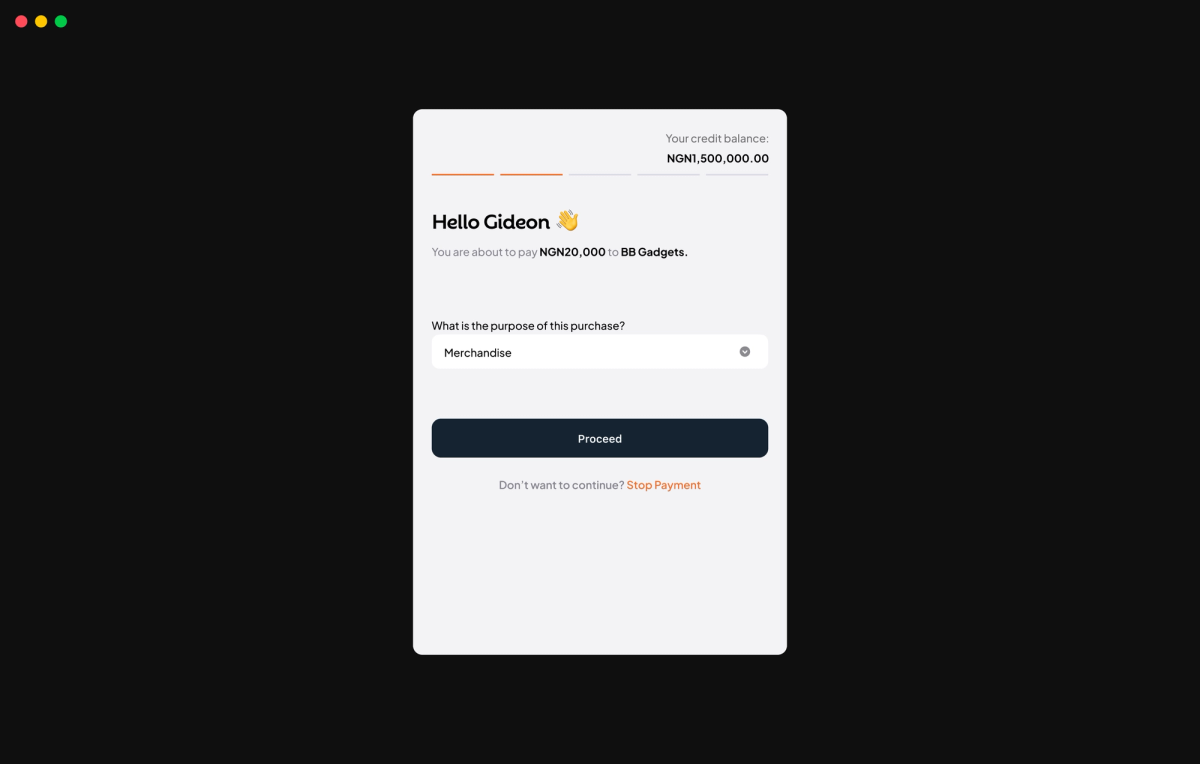
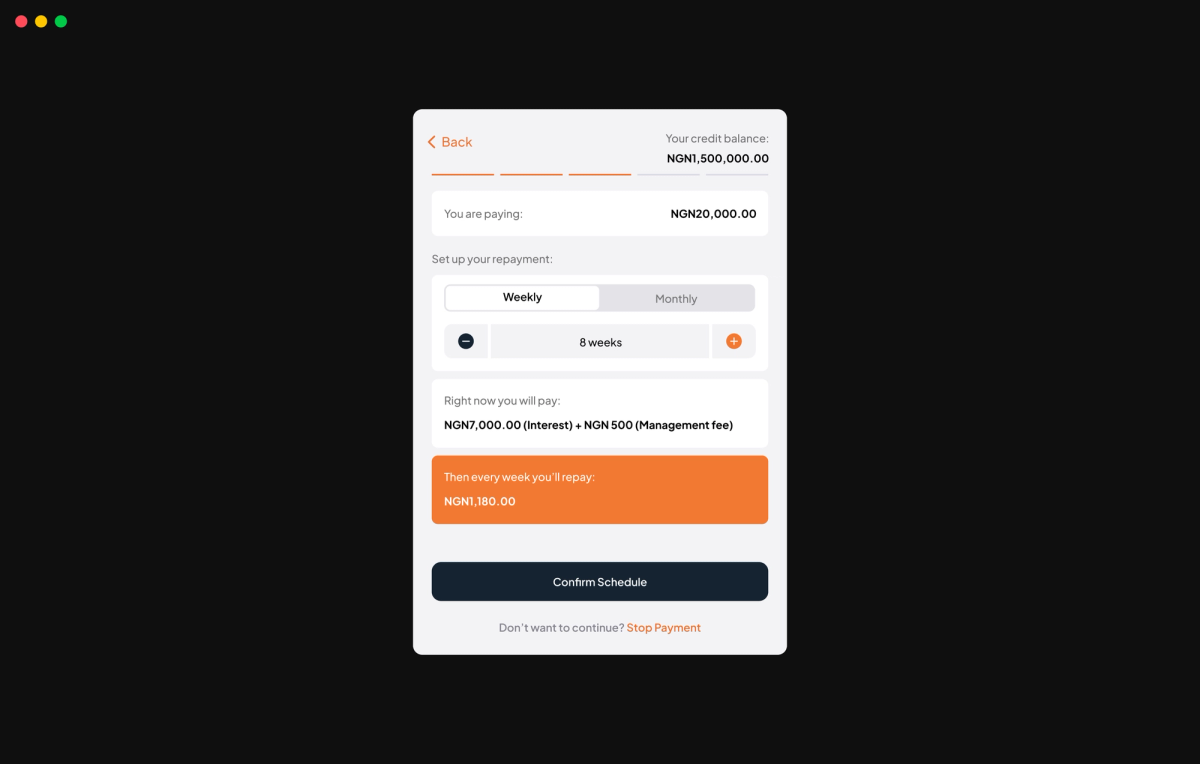
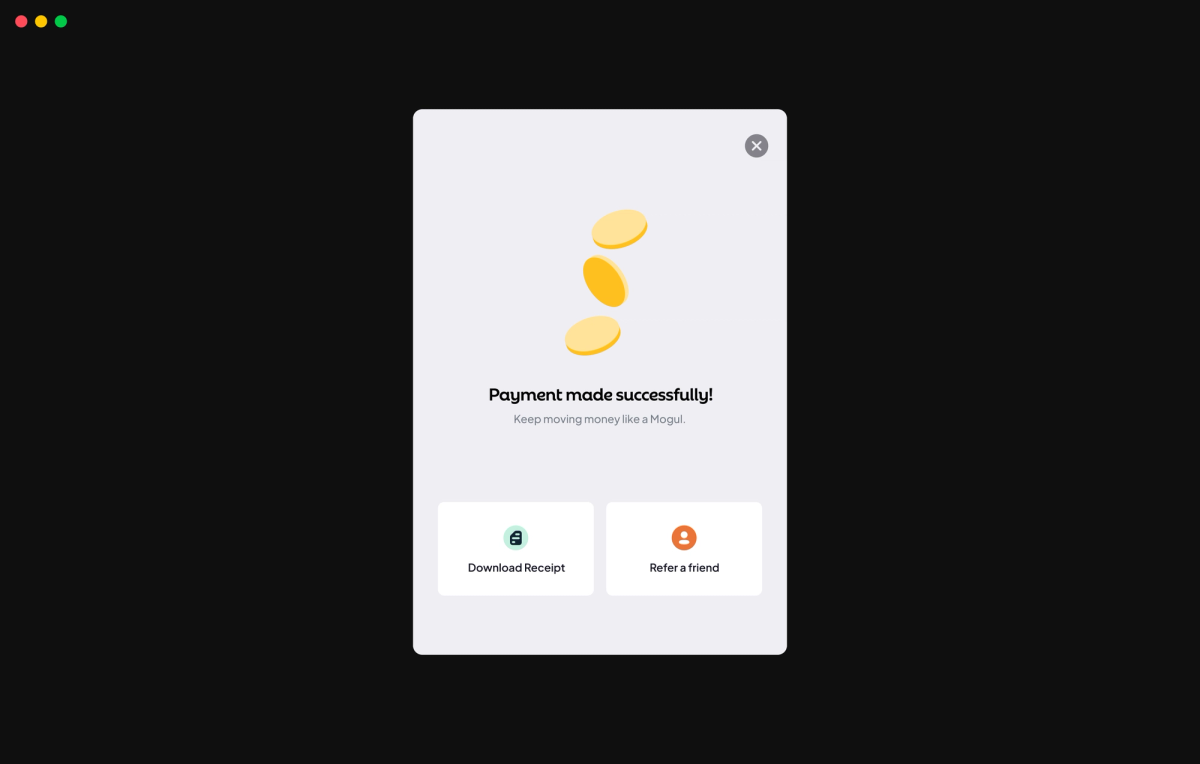
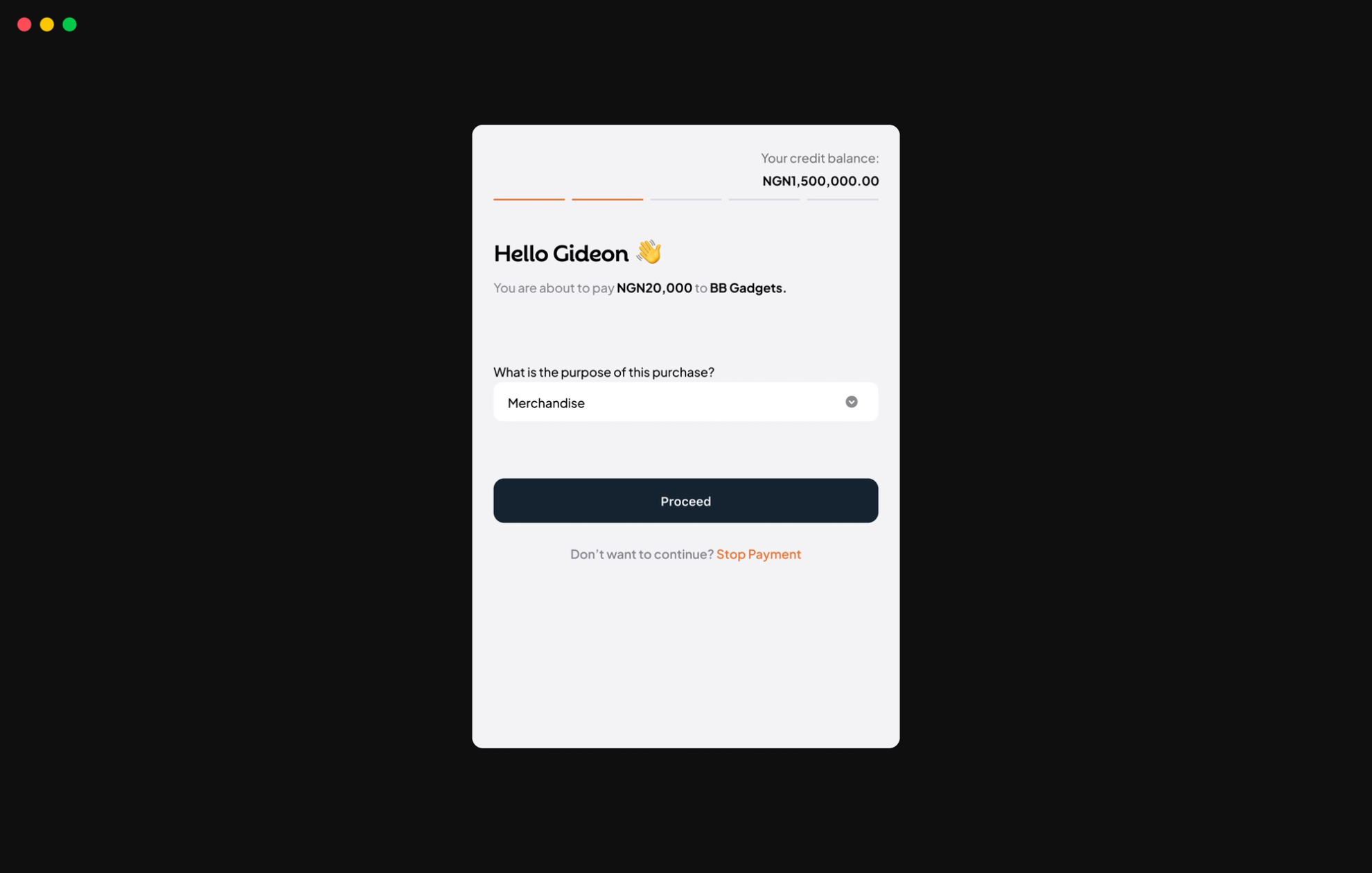
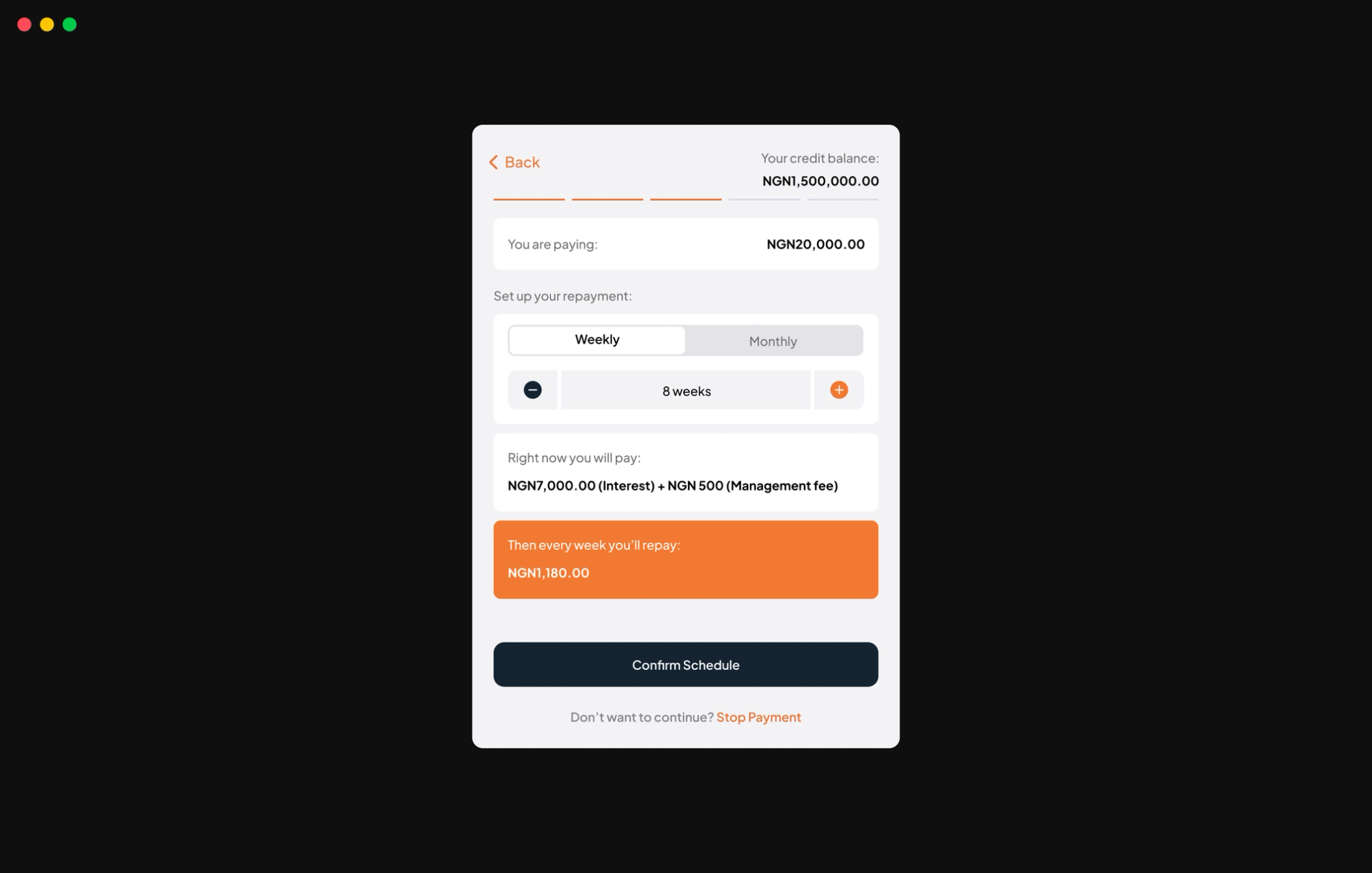
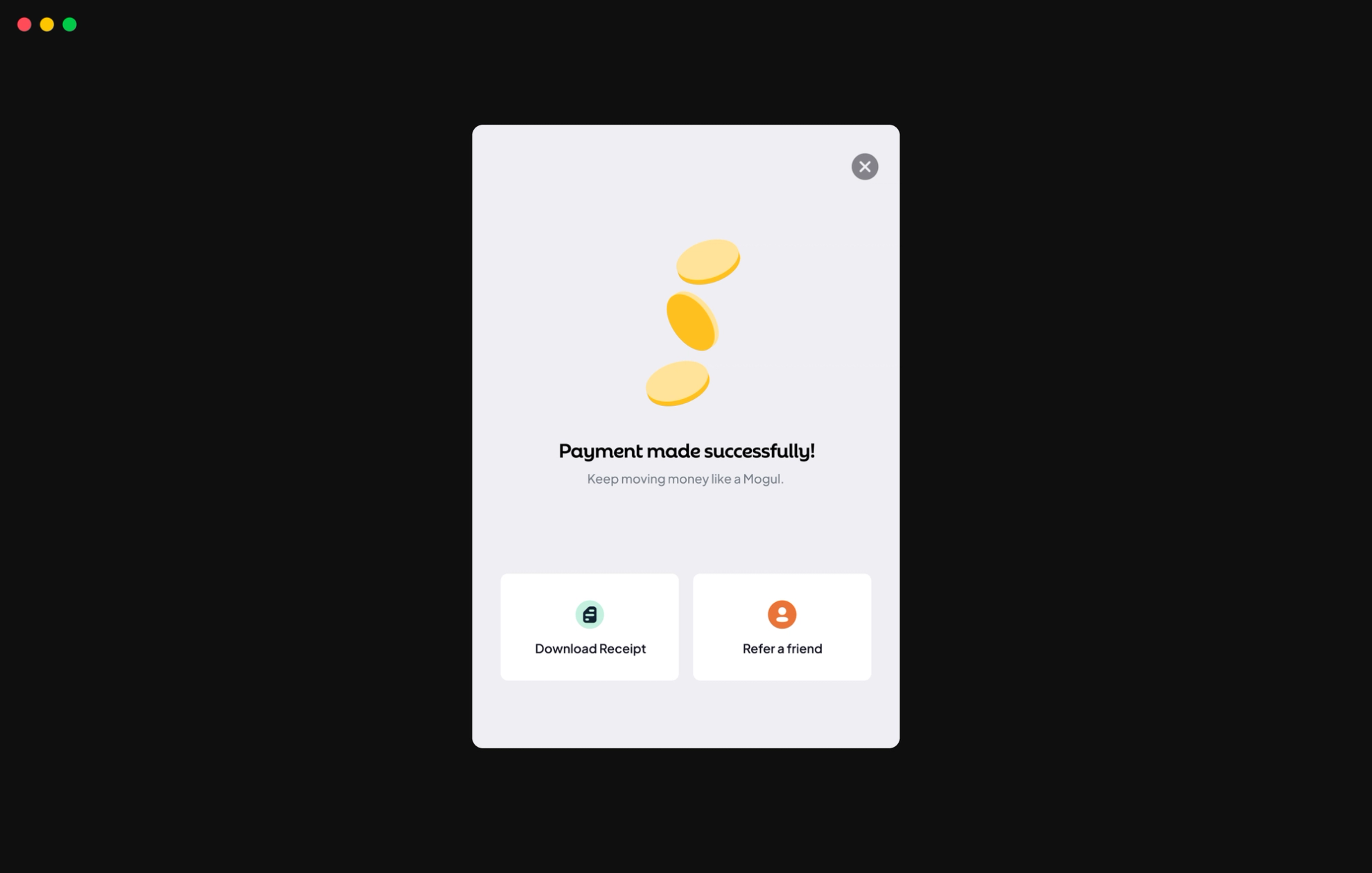
We partnered with vendors selling the assets and supplies businesses needed and created a vendor network. I designed the payment flow between business owners and vendors, allowing owners to pay for business needs with credit while Pennee paid vendors directly and collected repayment over time; essentially a BNPL model that kept credit within the business ecosystem.
The tradeoff was deliberate: less freedom in where credit could go, in exchange for a higher chance it reached the business.
I designed the payment experience to be fast and flexible, accessible through checkout links or QR codes. Credit decisions and commitments were shown upfront, so users understood what they were committing to before paying, with contextual guidance available when needed.
Thorough but progressive KYC
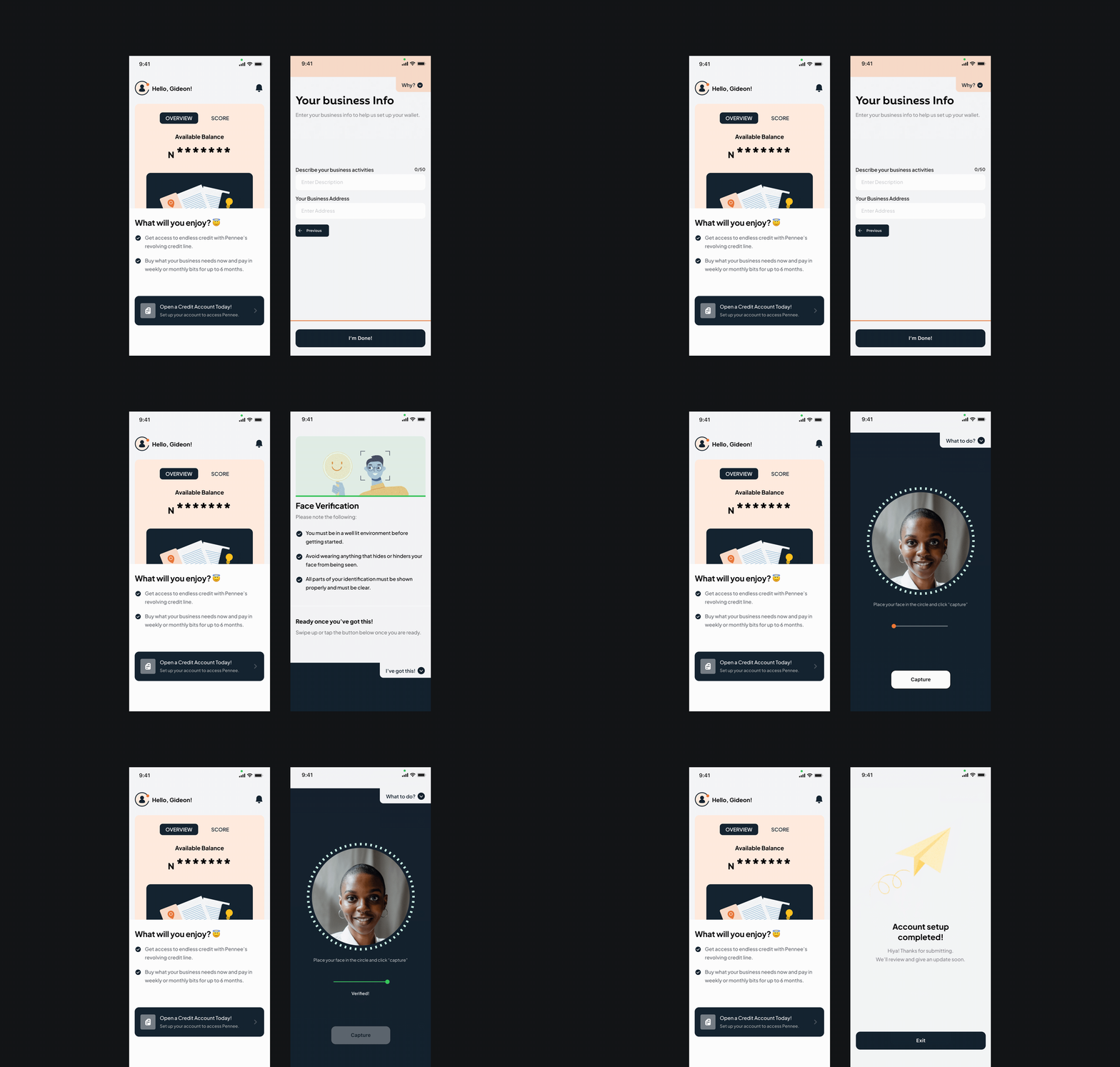
Changing the financing model made eligibility more important. If Pennee was going to offer credit responsibly, we needed enough information to determine whether someone could use and comfortably repay it. That meant collecting personal details, business details, documents, guarantors, proof of address and ID, and connecting the business's bank accounts.
What didn't work
The first KYC flow I designed collected everything upfront in steps. The logic was straightforward: more information upfront meant more complete applications required to provide credit. In practice, I optimised for data completeness so aggressively that the implementation hurt completion itself. The requirements were too bulky, and most people gave up before finishing them. We were asking users for a lot of commitment before we'd given them much reason to commit.
What I changed
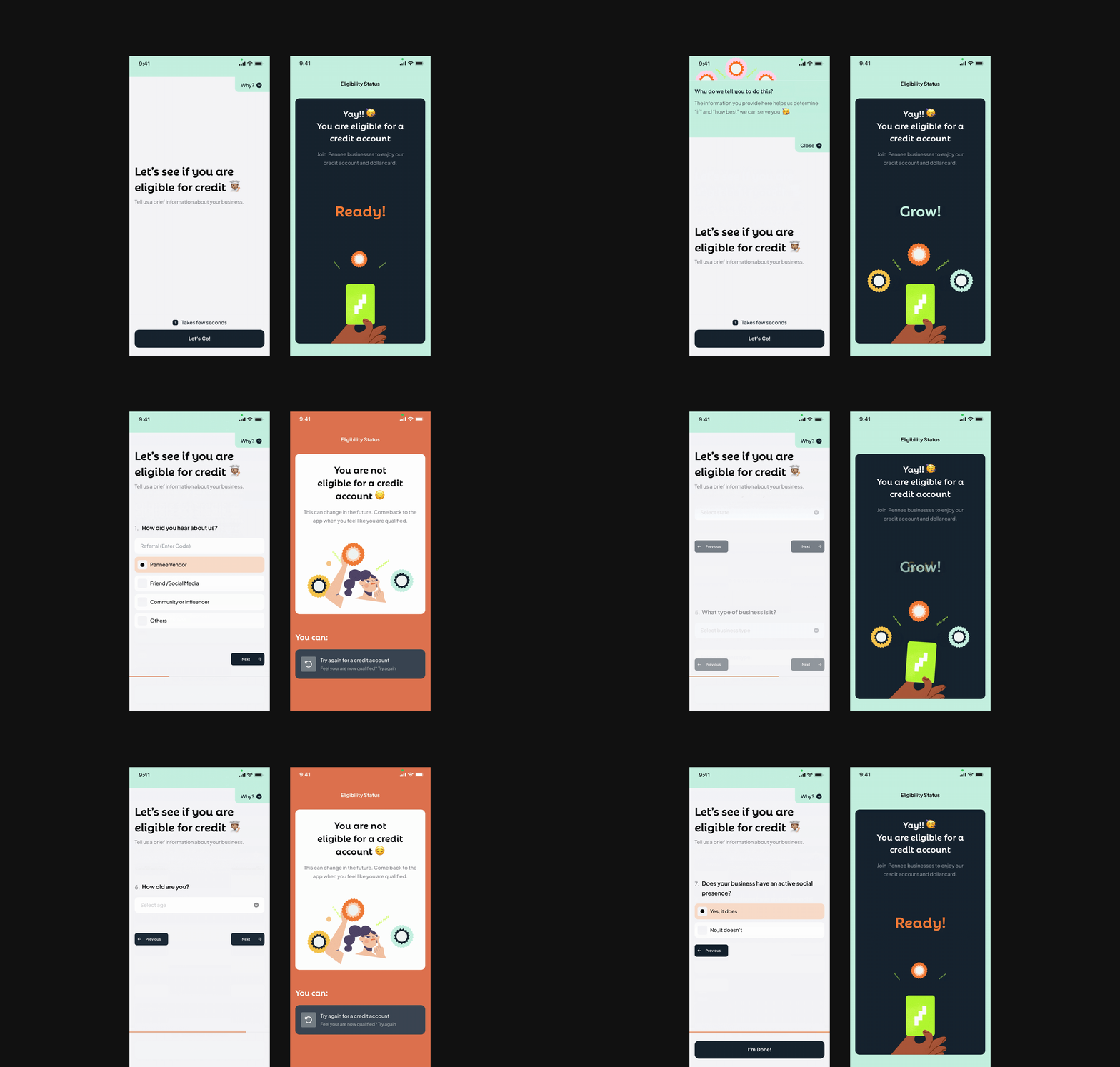
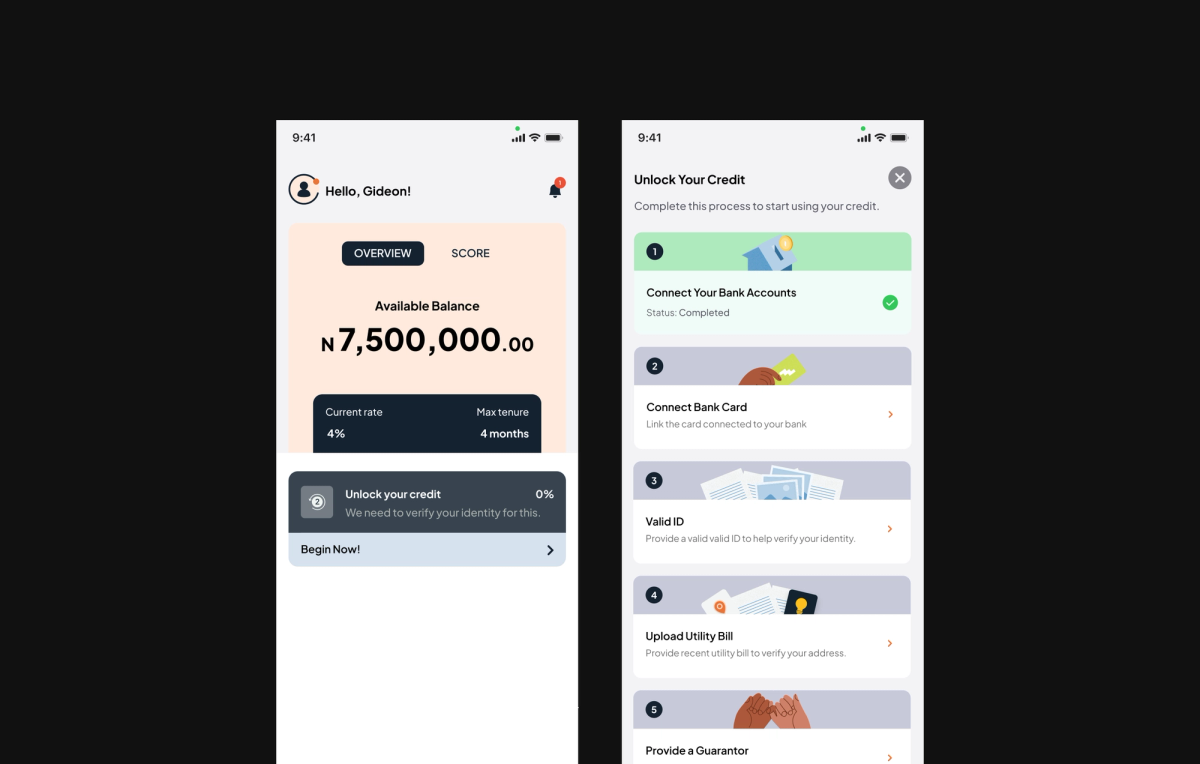
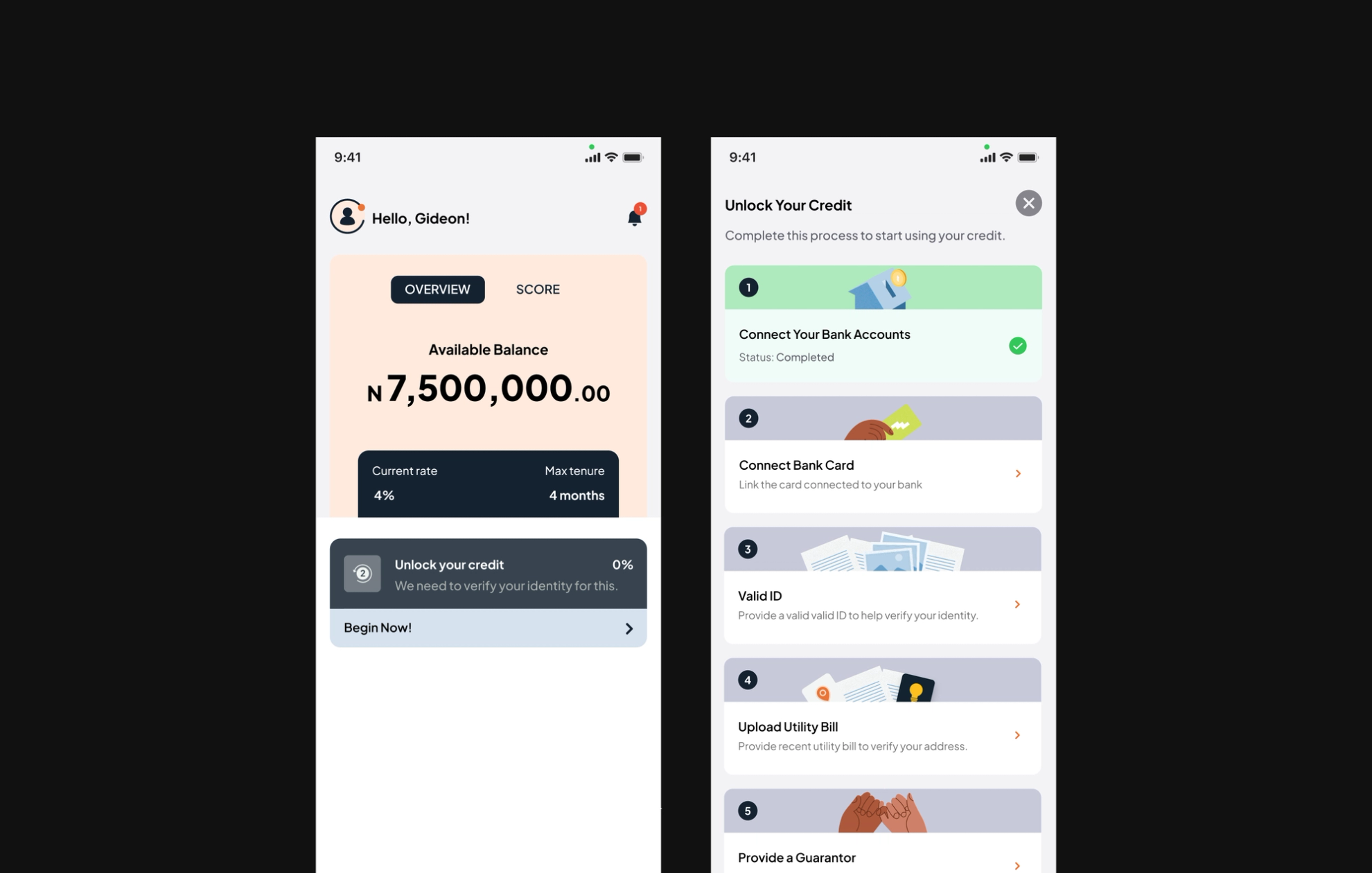
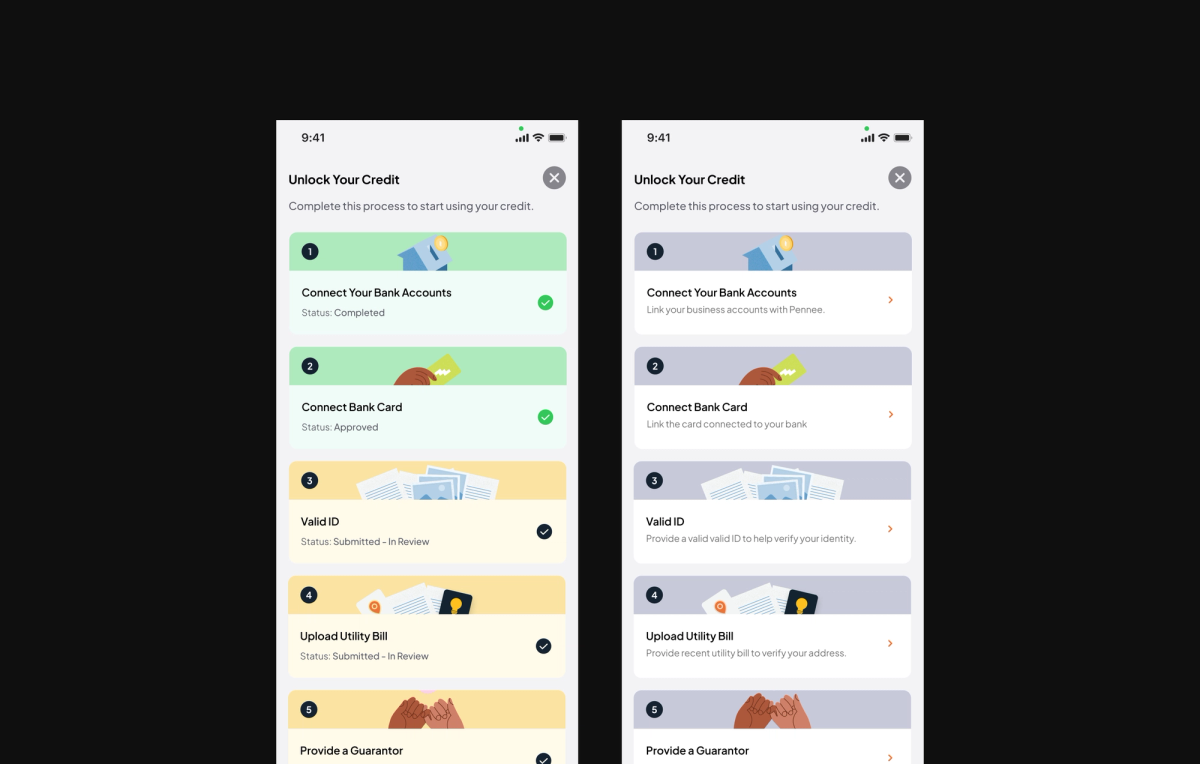
Instead of asking users to prove everything before Pennee gave them anything back, sign-up now started with just an email, phone number and a quick eligibility check. That was enough to immediately show an initial eligibility status; this way users know if they’ll be getting credit before committing to provide all the required details. Full KYC only began when someone decided to activate their credit account, and even then it was staged: personal and business information first, with address, ID, bank linking and guarantor information introduced only when the user got to the point in the flow where they became necessary.
Why it worked
The lesson wasn't that users were unwilling to complete KYC; we were asking for too much commitment before we'd given them a reason to commit. After the change, KYC completion increased from 24% of sign-ups to 81%.
A transparent verification flow
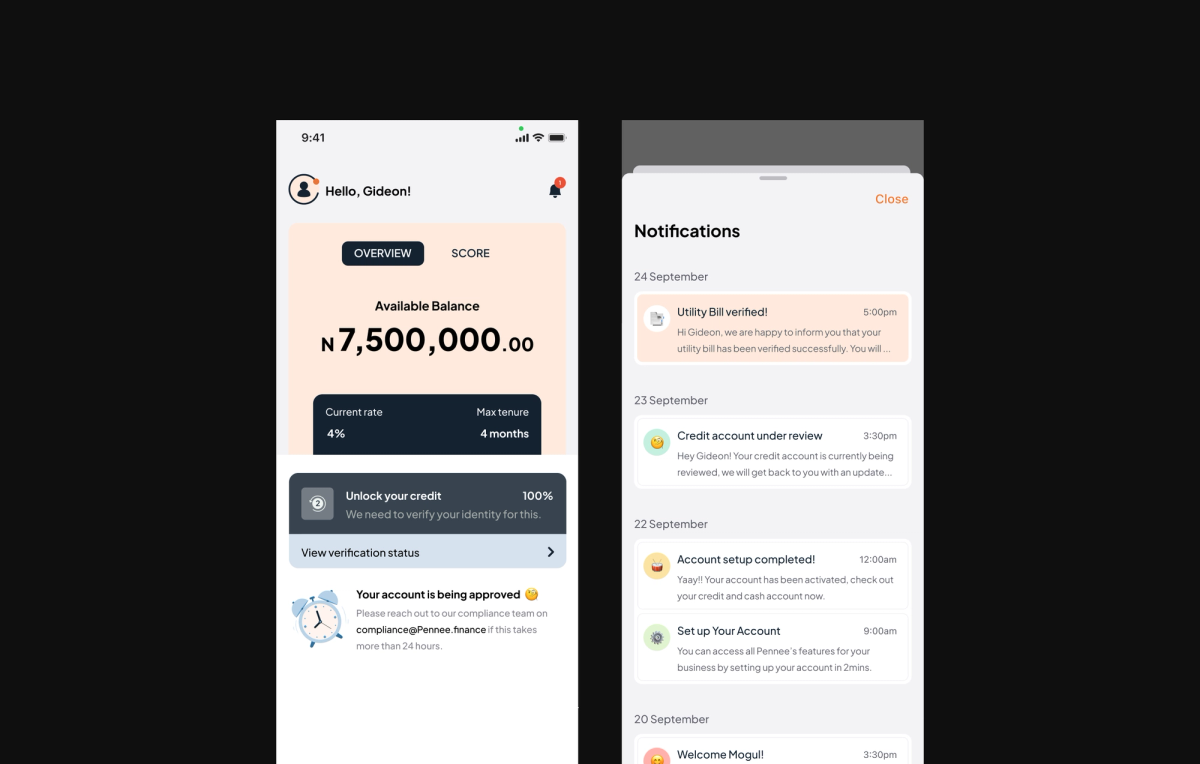
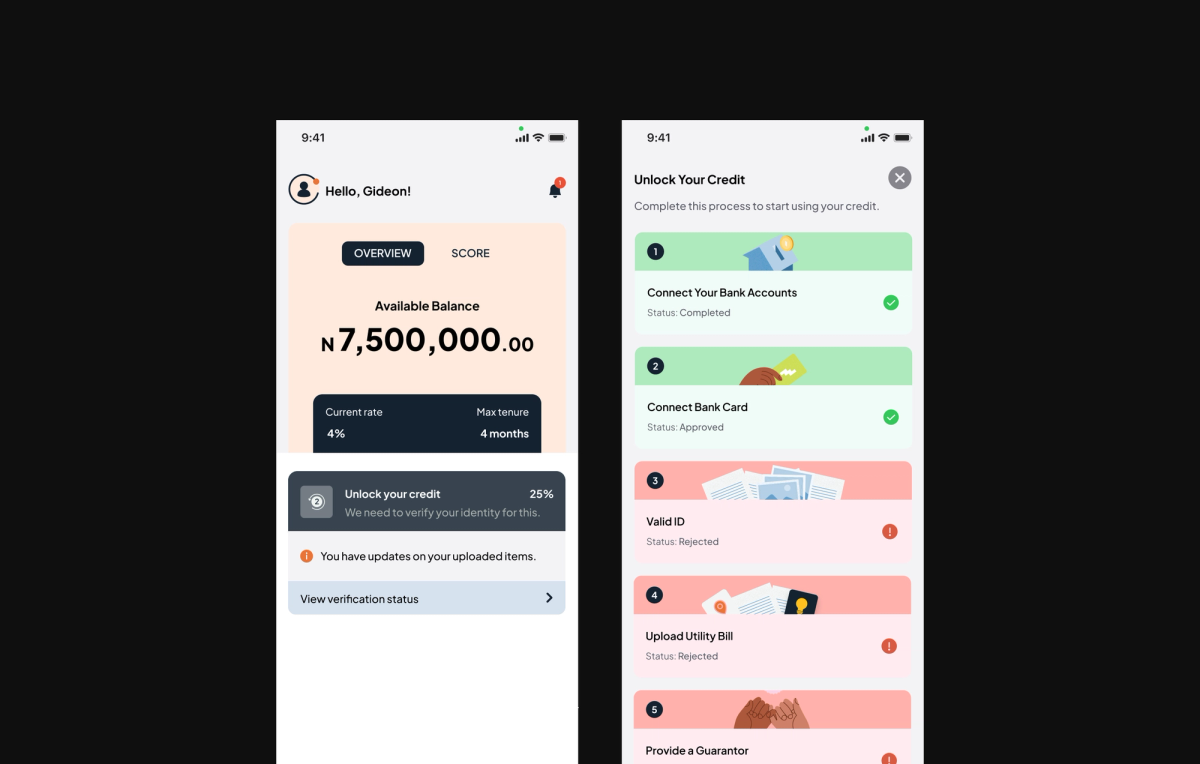
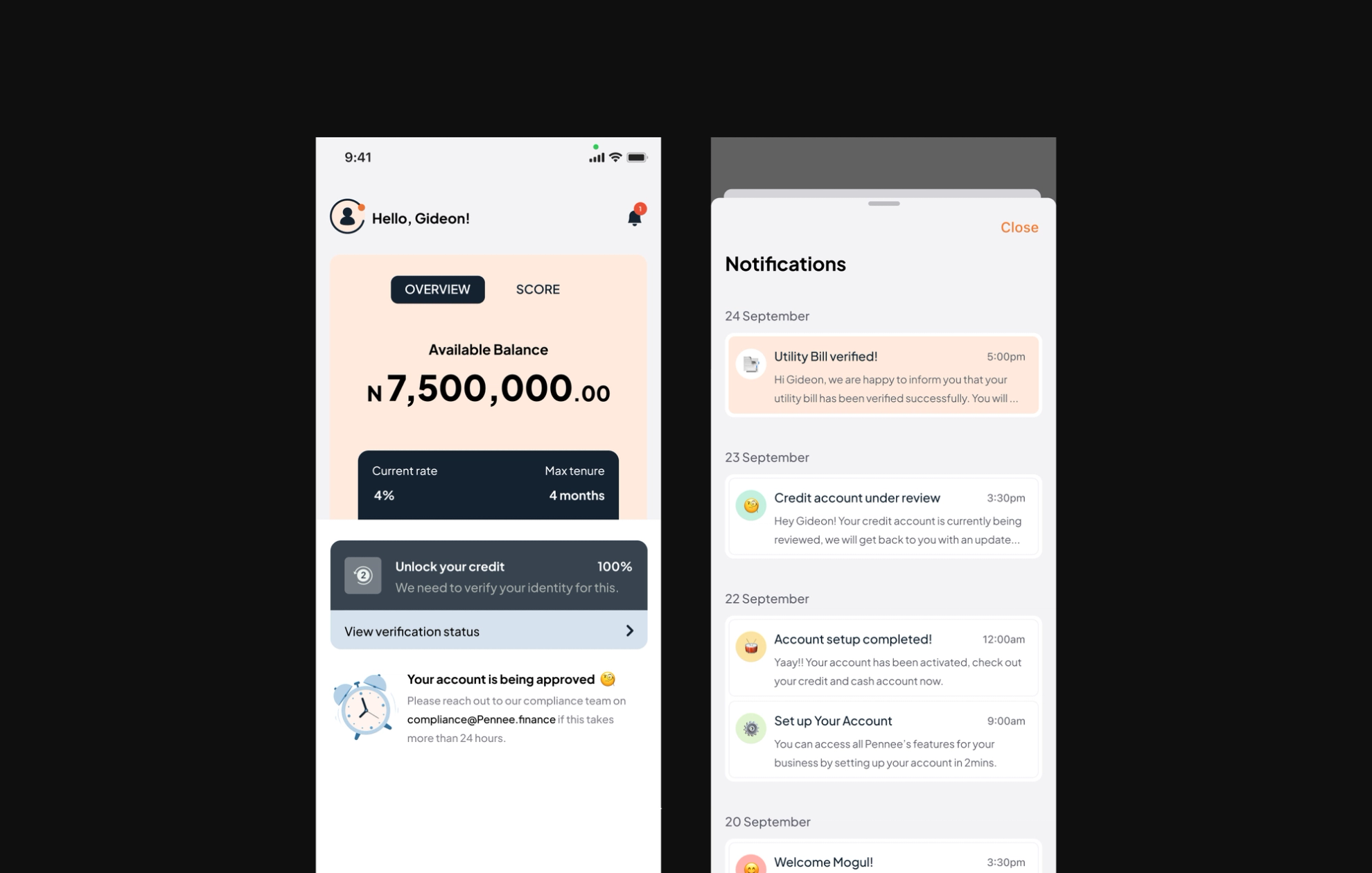
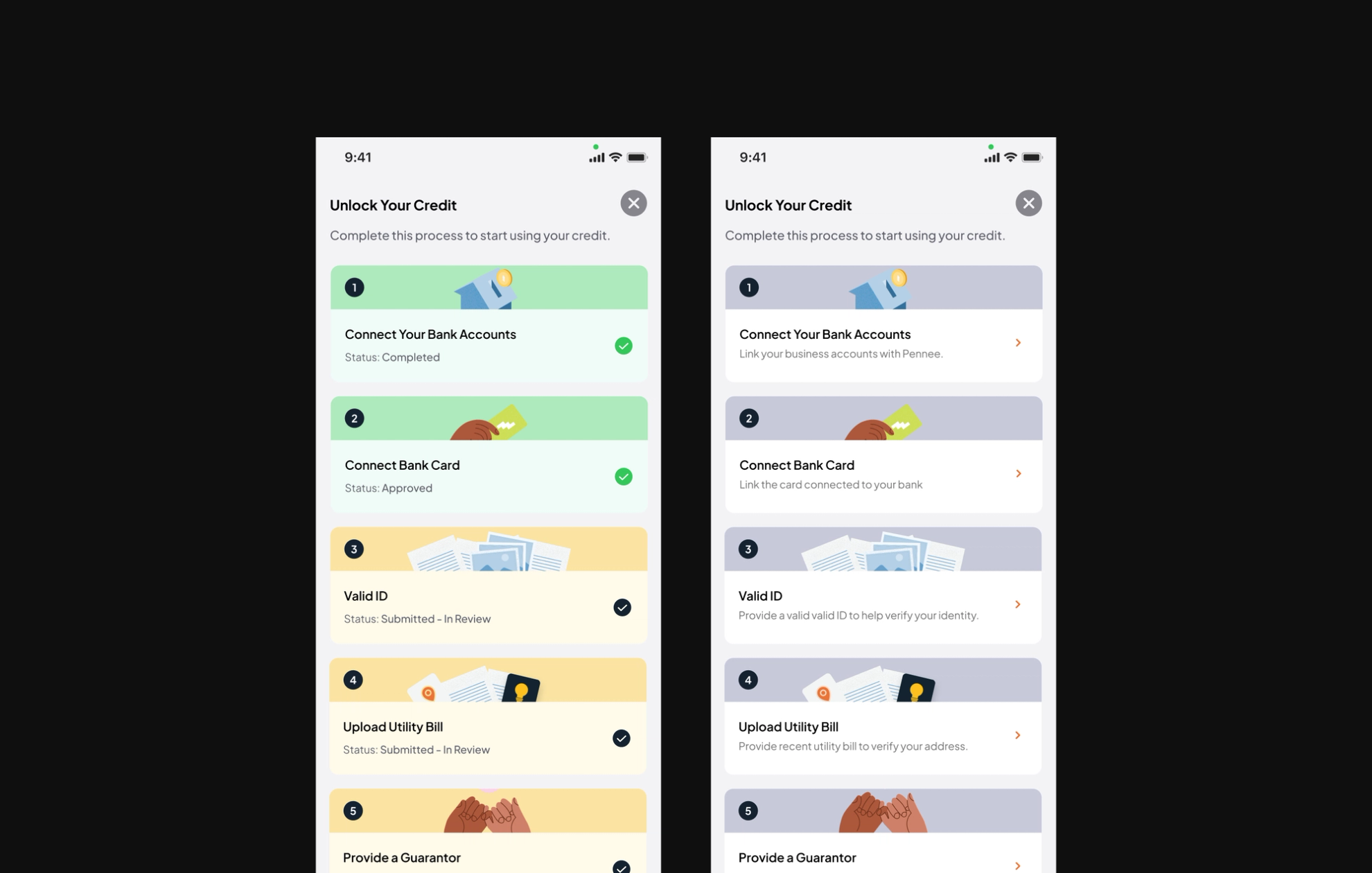
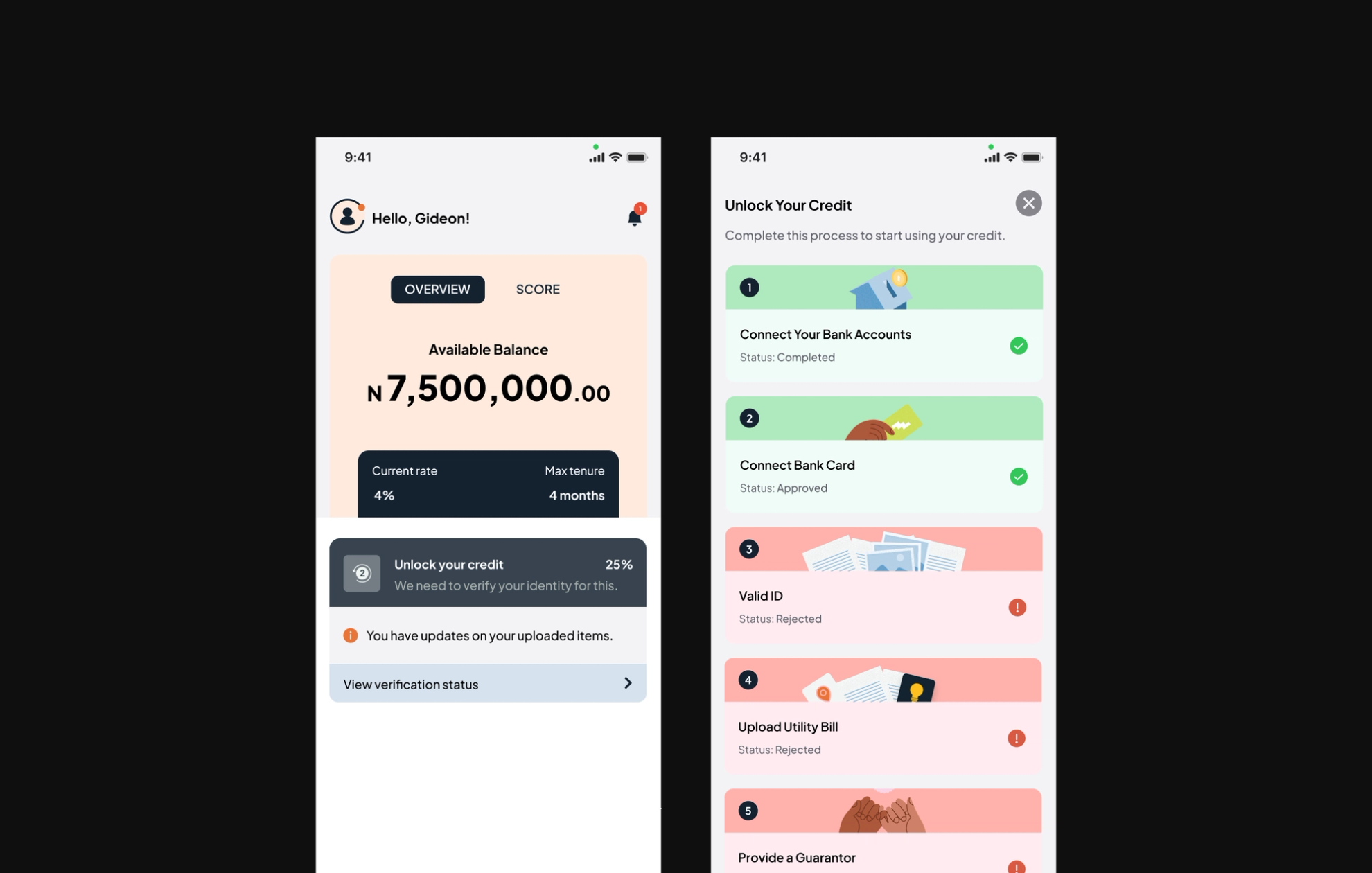
Progressive KYC got more people through the application. Then another bottleneck became more visible: Verification wait time. My first design iteration was to show "In review" during the wait period and notify them once we were done reviewing, but this led to overwhelming support tickets for review progress and delay inquiries. "Under review" told users almost nothing about what was happening; even upon completion of the review ", Rejected" told them what had gone wrong without providing them a way back in.
What I changed
Seeing how this led to more concerns for users and more workload for us, I started to approach the verification experience less from showing a status and more about explaining the process behind that status. Instead of a generic verification state, I designed a way for users to see the exact document currently being reviewed and the status of individual documents as the process continued.
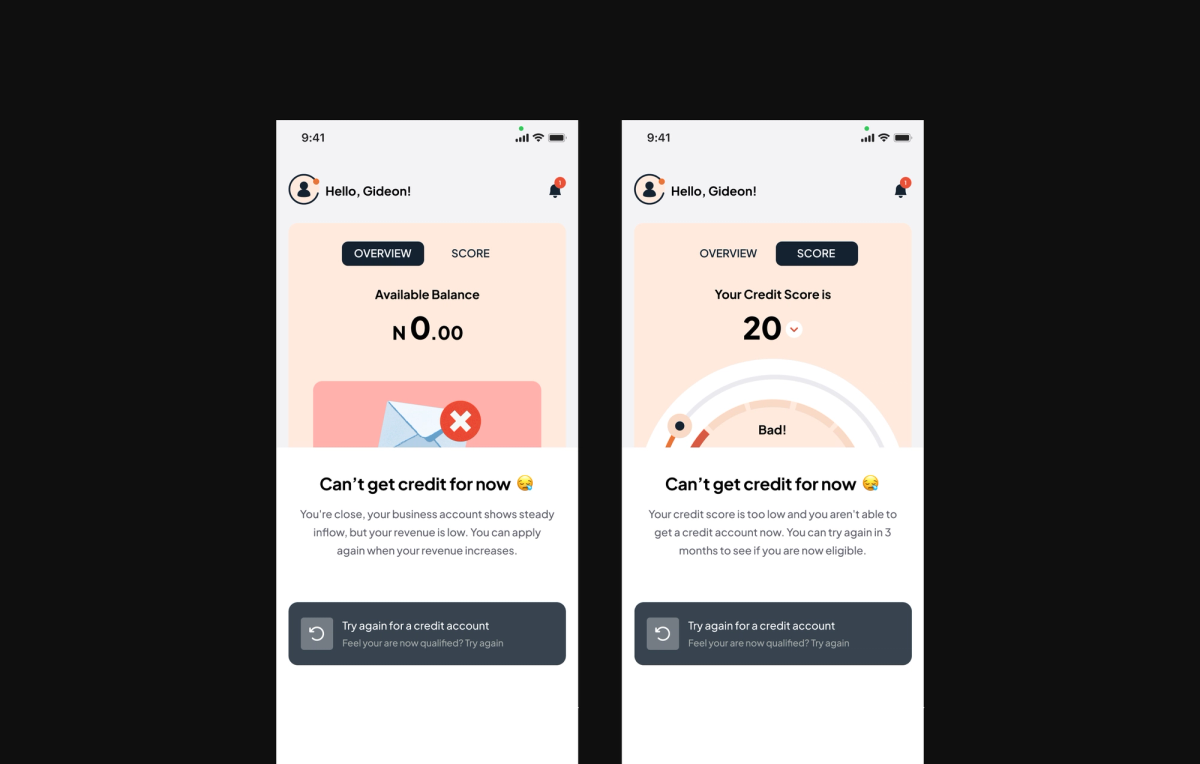
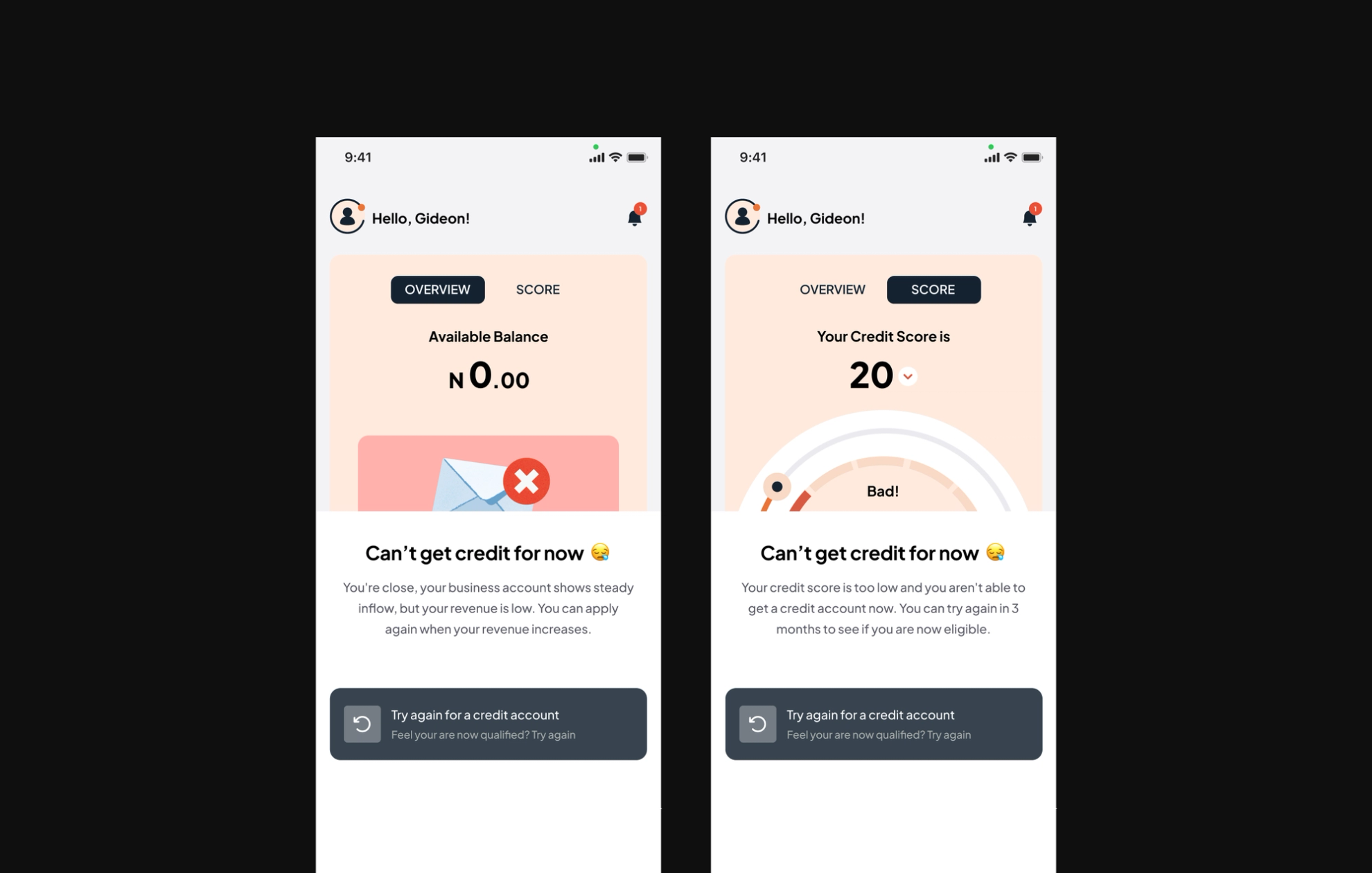
Rejection that tells you how to fix it: I treated rejection the same way. Instead of: "Your application was not approved." I designed declined applications to show:
"You're close. Your business account shows steady inflow, but your revenue is low. You can try again in 3 months to see if you're now eligible."
This shows the reason for rejection and a way back in when they feel eligible again. Rejection changed from a dead end into something users could act on.
The result
Our review inquiry tickets decreased by 60%; 34% of users who received the new rejection message returned after three months to check again, compared with roughly 4% after the previous flat rejection.
The broader lesson was simple: Transparency didn't require making the underlying credit decision simpler. It required making that complexity understandable to the person waiting on it.
Credit purchase and repayment
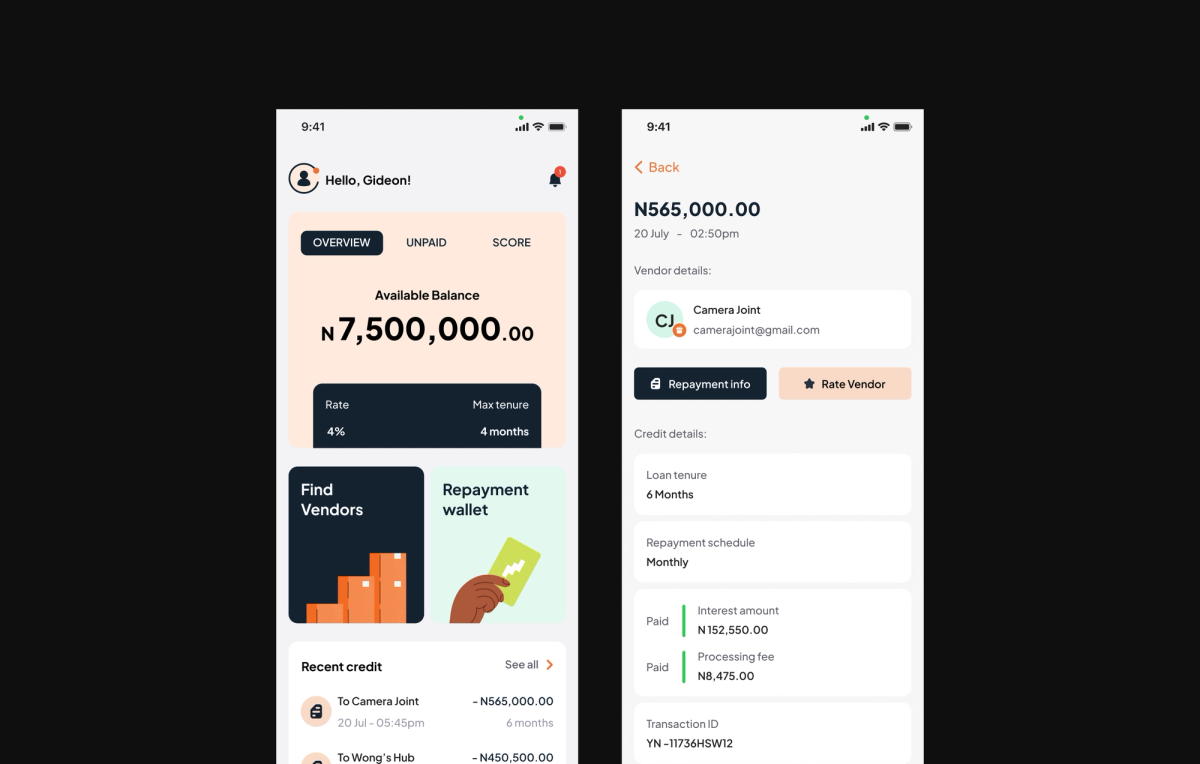
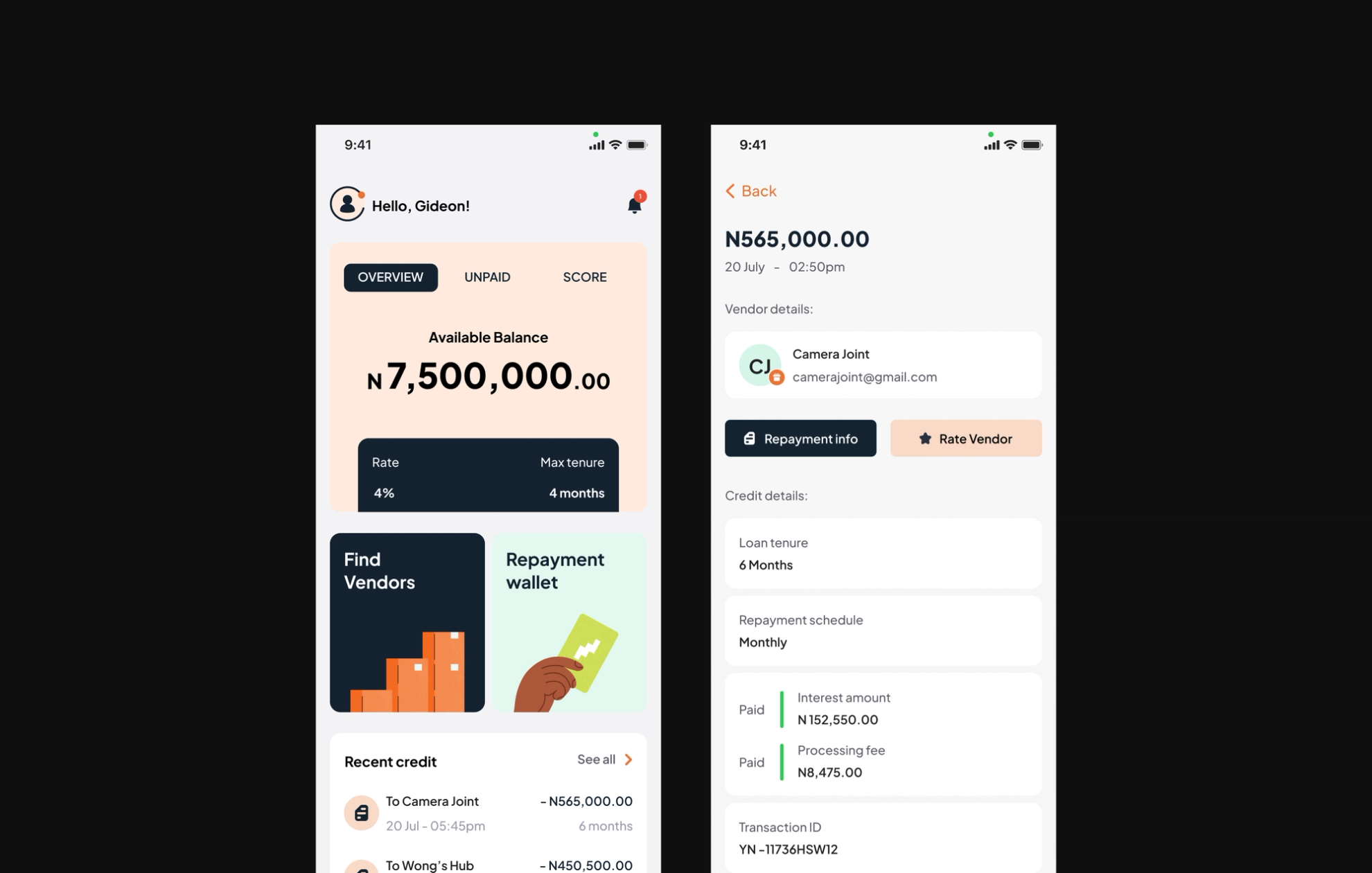
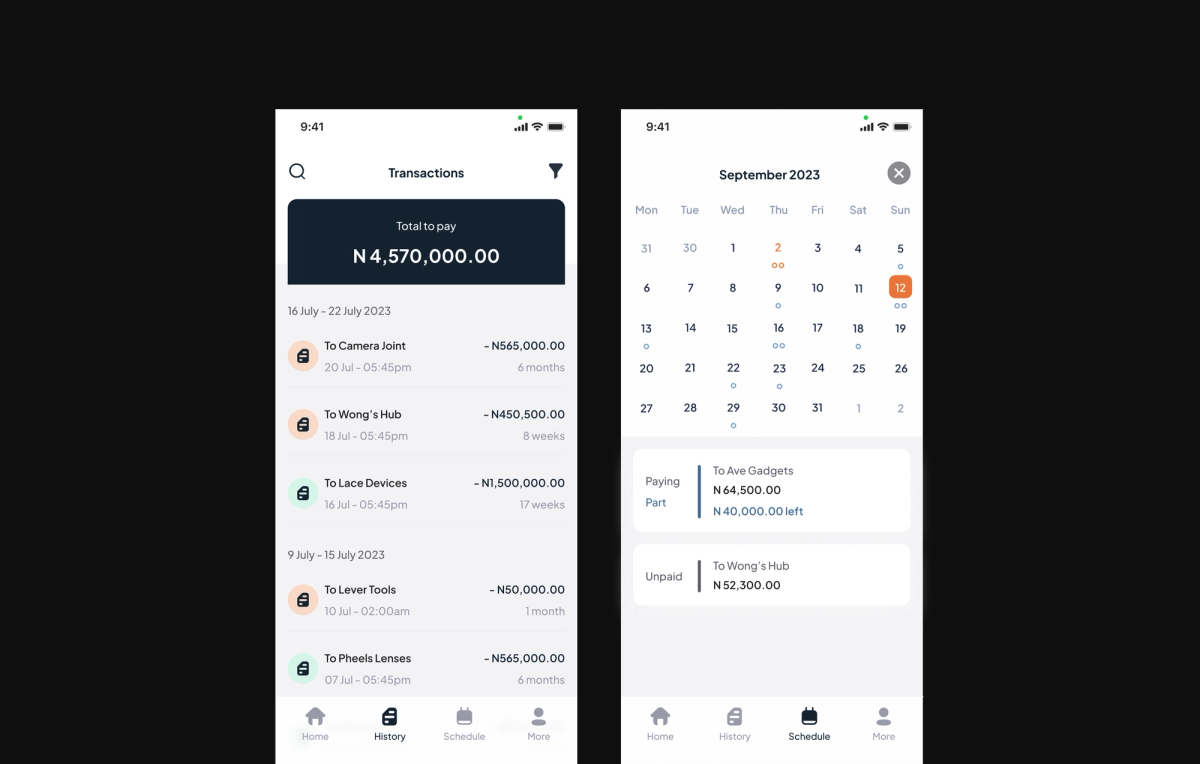
Once approved, the credit still needed to feel simple when someone actually used it. Business owners could pay supported and verified vendors using a Pennee payment link. The amount was deducted from their available credit and logged as a new credit transaction, beginning its repayment cycle.
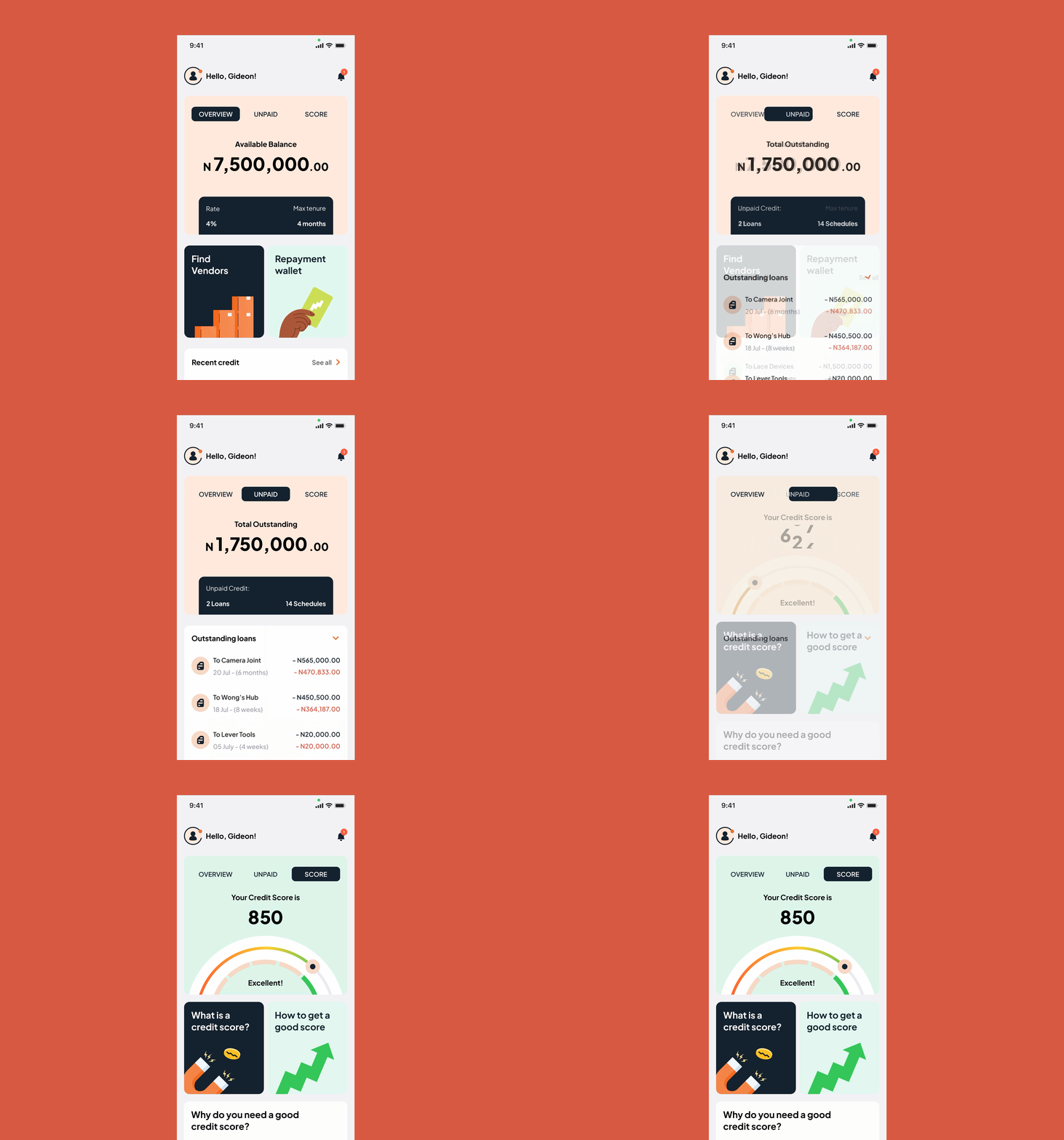
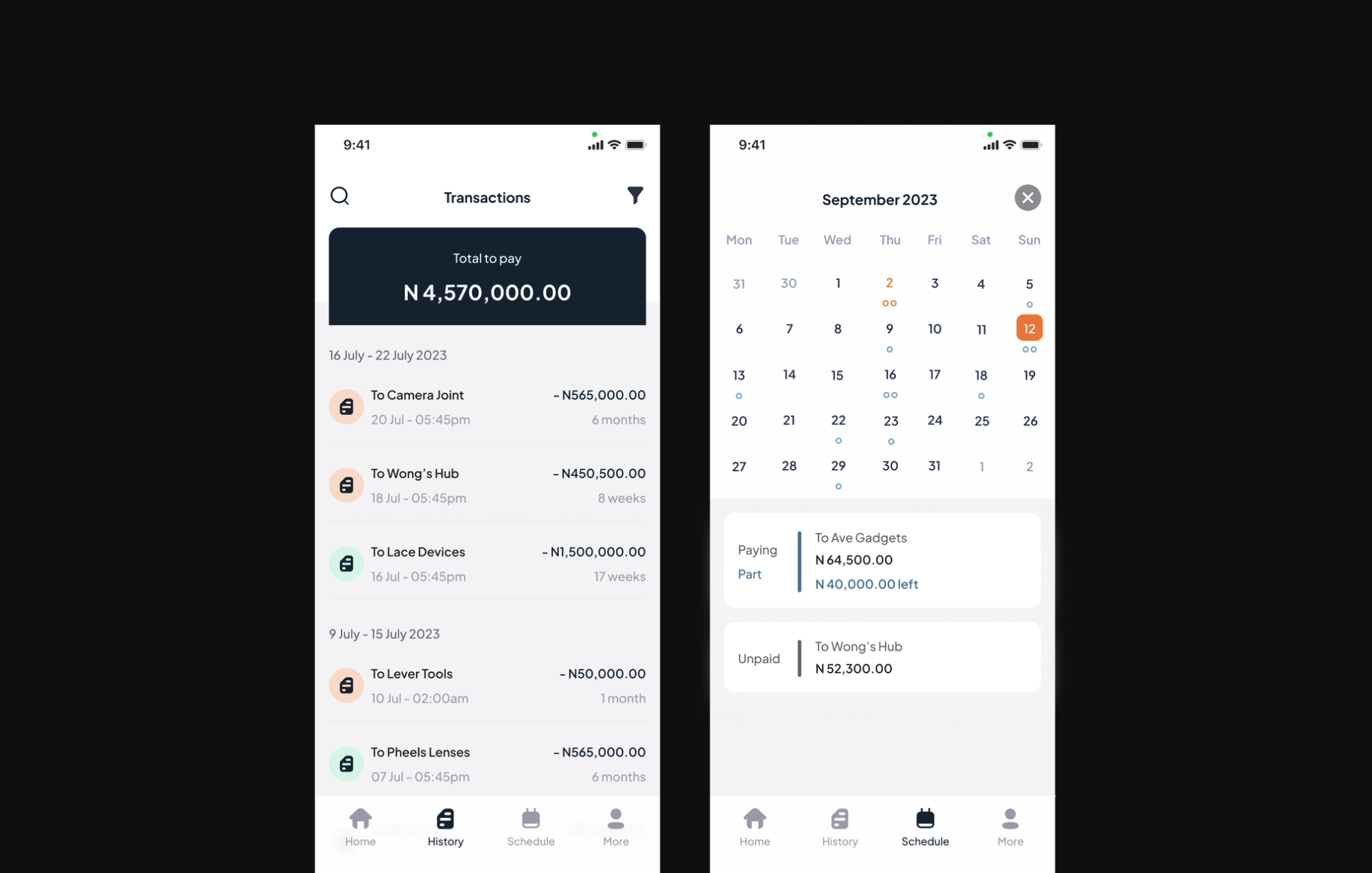
Users could manage those transactions through a history view or calendar view, giving them a clearer picture of their credit and when repayments were due.
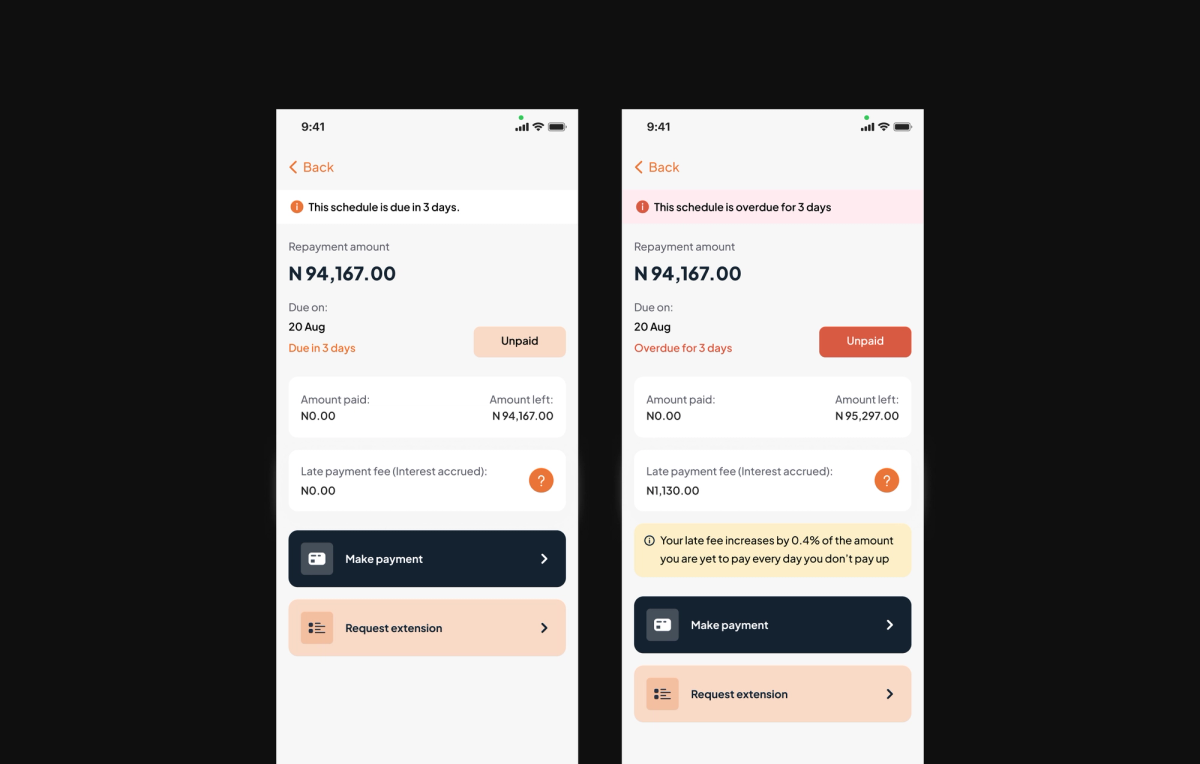
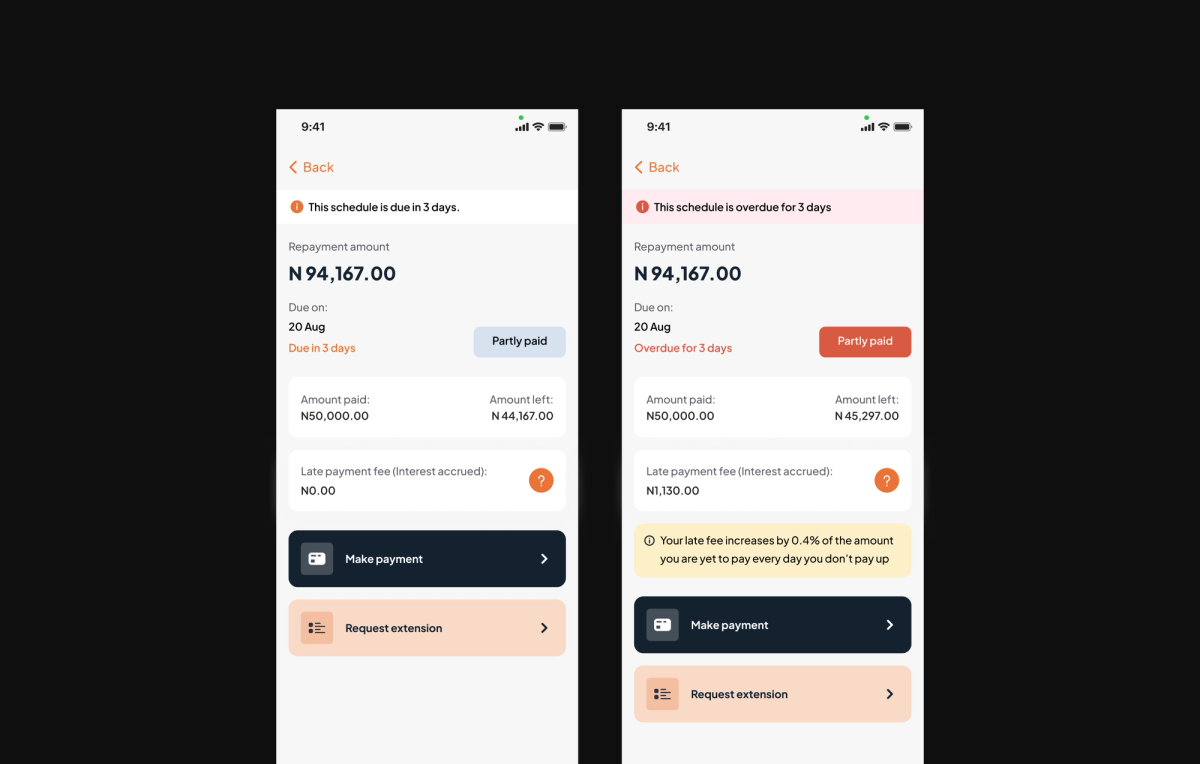
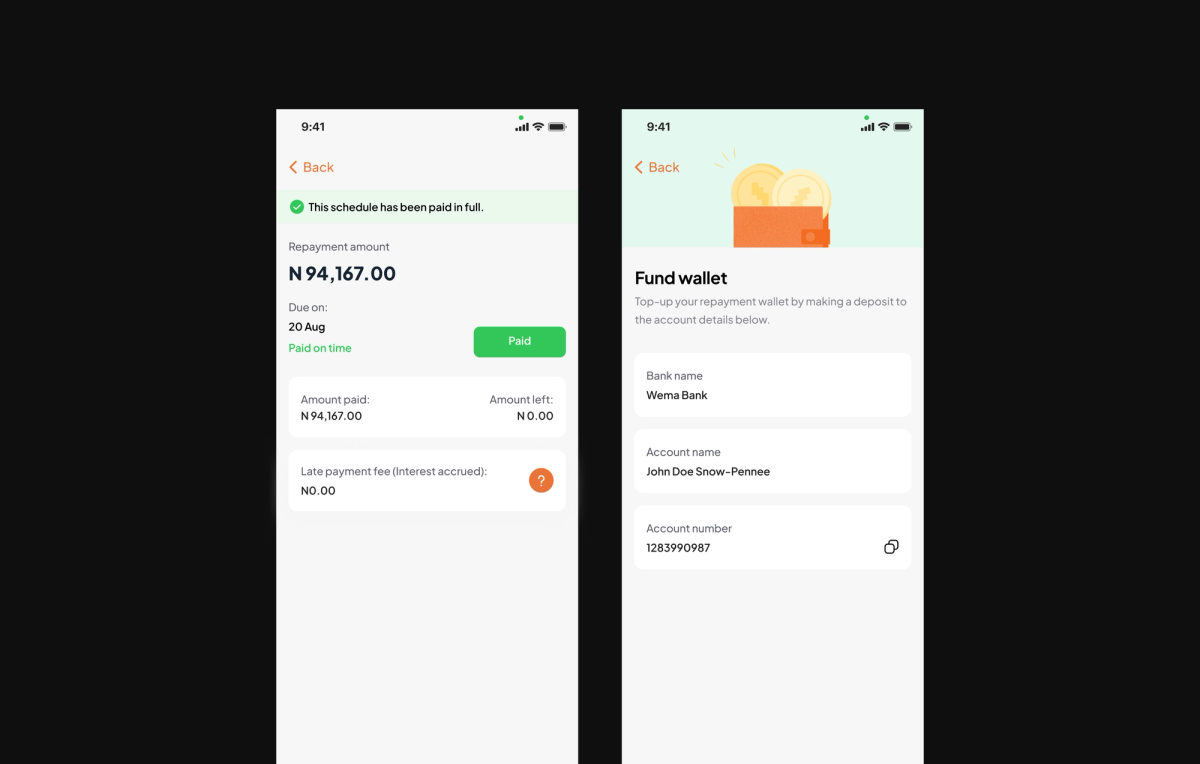
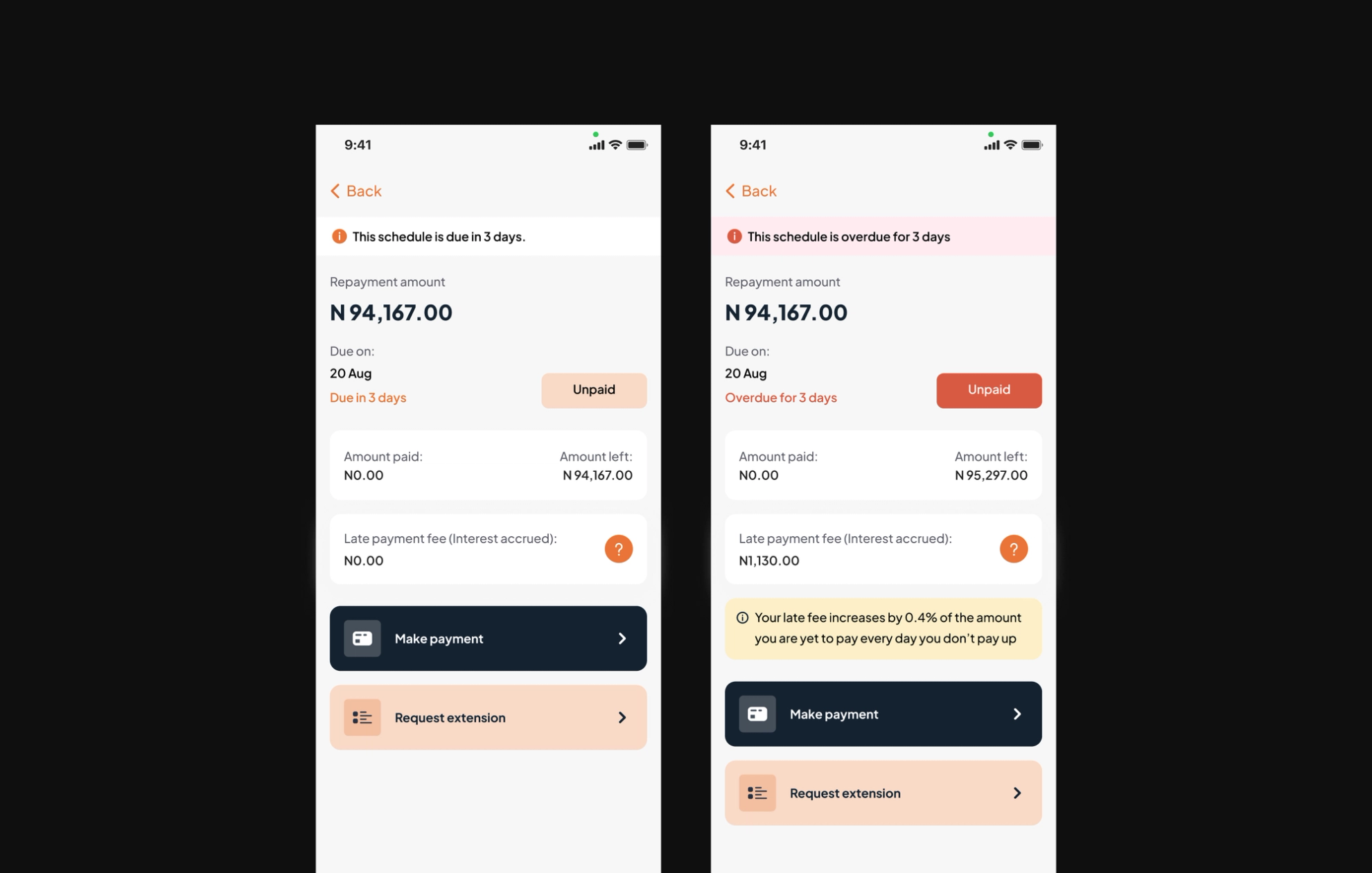
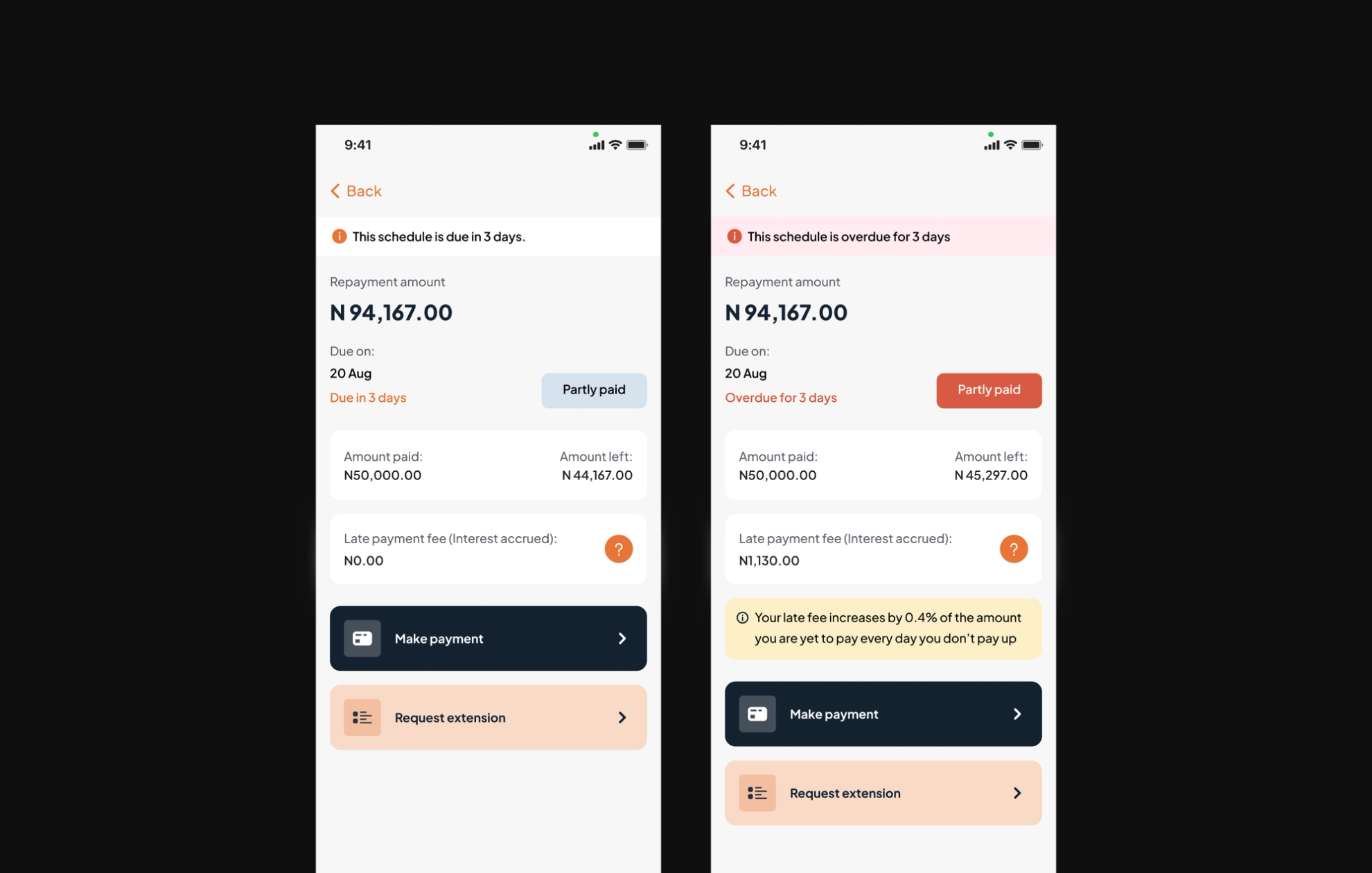
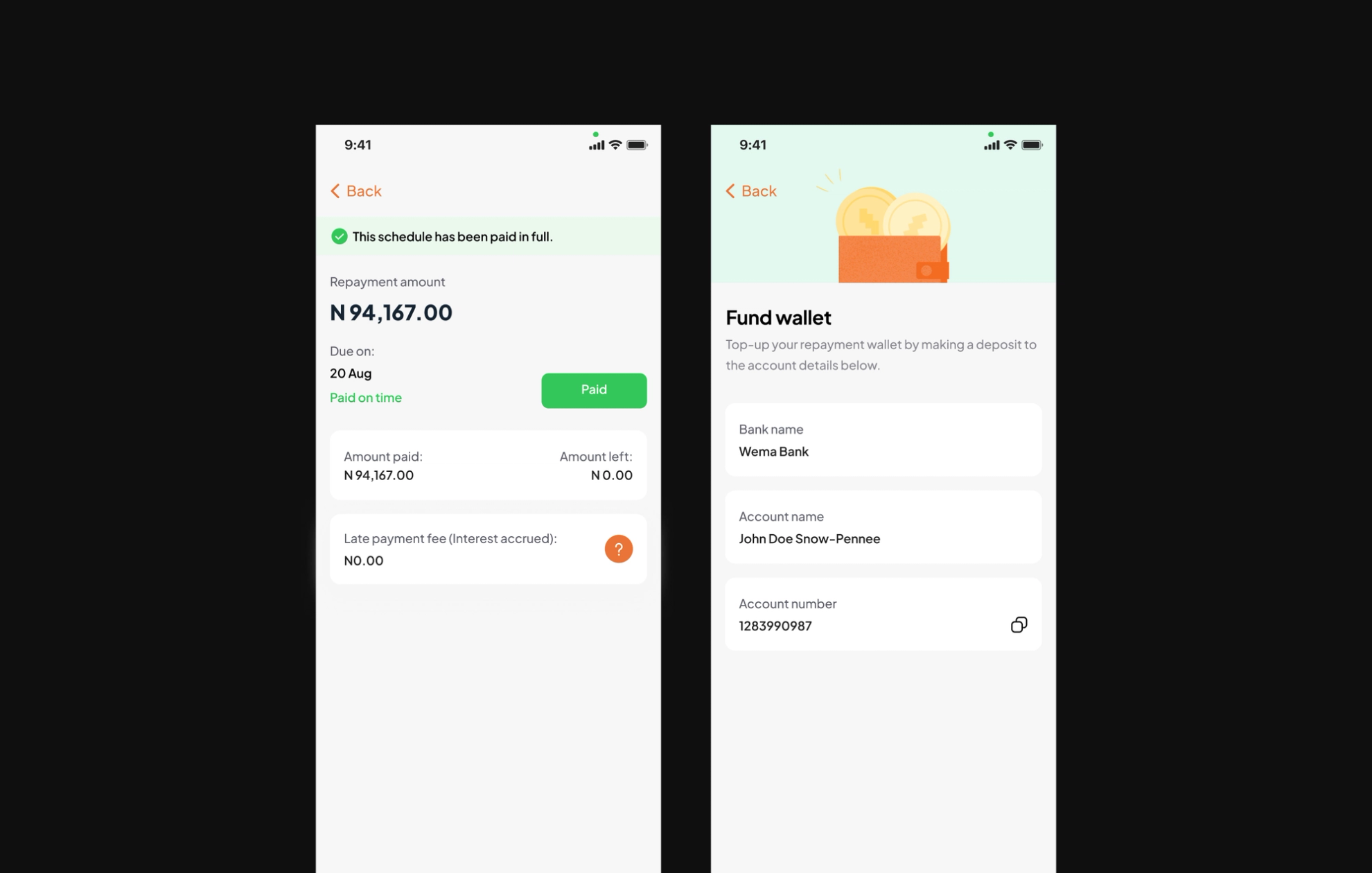
I designed all the states required to manage the full payment lifecycle for every loan: unpaid, partly paid, and fully paid, across different due states: due soon, overdue or restructured. Each state has its own screen and widget treatment, notification, and next action.
These changes helped users better manage their credit. Active loans on the platform increased by 50%, and the repayment ratio increased by 28%.
Bringing it together
Asset financing controlled where credit went, KYC and eligibility ensured only reliable users could access it, verification made those decisions understandable, vendor payments linked credit to business needs, repayment closed the loop.
Together, these decisions turned a requirement-heavy credit system into a clearer experience: prove you're a reliable business who will spend on your business and repay diligently, get approved, finance what you need, pay your supplier, manage repayment, and use your credit again.
The Impact
In the ten months following the redesign:
- 72,000+ businesses were activated, nearly 5× the previous total.
- 97% of users used their credit directly for their businesses, up from just 16%.
- KYC completion increased from 24% to 81%.
- Average verification time dropped from over 2 days to under 20 hours.
- Repaid loans increased by 28%.
- Active loans increased by 50%.

There were unexpected wins too:
24% of newly activated users referred another business owner within their first 60 days, something we hadn't specifically designed for.
Business owners also started manually referring their own suppliers so we could add them to the vendor network. That behaviour revealed another opportunity, so I designed a business owner-to-vendor referral feature, turning something users were already doing manually into part of the product itself.
What Worked, What I'd Change
The biggest thing that worked was stopping ourselves from treating the original solution as the problem we had to preserve. We could have made the cash-loan experience better and still failed to solve the underlying problem.
Progressive KYC was also a big win; my first all-upfront, step-by-step approach was technically thorough but practically ineffective. Progressive KYC solved this because I stopped optimising only for what Pennee needed from the user and started considering when the user had enough motivation to give it to us.
If I were revisiting the product, I'd pay more attention to what happened after businesses entered the vendor-financing ecosystem. Restricting credit helped keep financing within the business, but it also made the usefulness of that credit increasingly dependent on the strength of the vendor network.
The biggest lesson I'd take from the project is that good UX wasn't always about giving users more freedom or removing more steps. Sometimes the right constraint made the product work better.

0%...
Because the smallest design
decisions can change how we
all experience the world...